


Dreadlock Size Chart: How to Choose the Right Loc Size for Your Hair
-
- June 5, 2026

Most people choose their dreadlock size the same way they pick a Netflix show — they go with whatever looks good in the moment. And just like that late-night pick, they wake up with regrets.
Here’s what nobody tells you before you start: your loc size isn’t just a style choice. It’s a long-term commitment that affects how your hair grows, how much maintenance it needs — and honestly, how confident you feel every single day.
In our experience talking to hundreds of people at every stage of their loc journey, the ones who regret their size choice almost always say the same thing — “Nobody told me to think about it this carefully.”
Too small, and fine hair looks sparse and patchy. Too big, and your scalp shows more than your locs do. Get it right, and your dreads become the most powerful thing about your entire look.
This dreadlock size chart guide covers every loc size — from Micro to Extra Large — with real-life comparisons, and honest advice for every hair type. Whether you’re starting your first loc or reconsidering your current size, by the end of this dreadlock size chart guide, you’ll know exactly which size is right for you.
What Is a Dreadlock Size Chart? (And How to Read It)
If you’ve ever Googled “dreadlock sizes” and ended up more confused than when you started — you’re not alone.
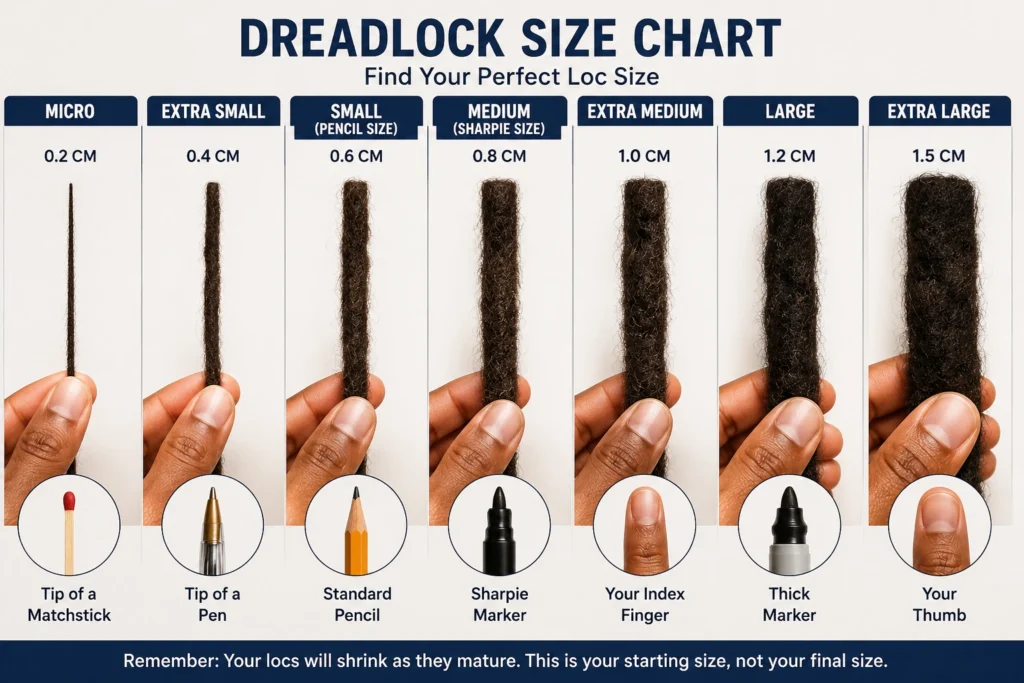
A dreadlock size chart measures the diameter of a loc — simply how thick it is when measured straight across. Think of it like measuring the width of a pencil. That’s all it is. No complicated math, no guesswork.
Sizes run from ultra-thin Micro locs all the way up to chunky Extra Large. Here’s the complete breakdown:
| Size | Diameter | Real-Life Comparison |
| Micro | 0.2 cm | Tip of a matchstick |
| Extra Small | 0.4 cm | Tip of a pen |
| Small (Pencil Size) | 0.6 cm | Standard pencil |
| Medium (Sharpie Size) | 0.8 cm | Sharpie marker |
| Extra Medium | 1.0 cm | Your index finger |
| Large | 1.2 cm | Thick marker |
| Extra Large | 1.5 cm | Your thumb |
Among these sizes, Small and Medium locs account for the majority of loc installations worldwide — making them the most tested and documented sizes for almost every hair type.
One thing most beginners don’t realize: the size you pick today is your starting size — not your final size. Locs shrink and tighten significantly as they mature. We’ll cover exactly how much in Section 5.
Each Loc Size Explained in Detail
Now that you’ve seen the dreadlock size chart, knowing the numbers is one thing. Knowing what each size actually feels like to live with — that’s what helps you make the right call.
Micro Locs (0.2 cm)
Micro locs are the smallest you can go — and they’re not for everyone.
These ultra-thin locs look incredibly neat, almost like thin braids from a distance, and they move beautifully. But they require serious installation time — sometimes an entire day — and constant upkeep to stay looking their best. They work best on fine to medium hair textures. Thick, coarse hair will fight you every step of the way.
Best for: Fine hair, people who love a polished look and can commit to regular maintenance. Not ideal for: Thick or coarse hair, busy lifestyles with limited maintenance time.
Extra Small Locs (0.4 cm)
Extra small locs are micro locs’ more relaxed sibling.
They still give you that neat, defined look with slightly less installation time. They’re popular for thin or low-density hair because more locs naturally means better scalp coverage. Just keep in mind — smaller locs mean more retwisting sessions and longer maintenance appointments.
Best for: Thin or low-density hair, people who want good coverage without going full micro. Not ideal for: Anyone looking for a low-maintenance routine.
Small Locs — Pencil Size (0.6 cm)
This is the sweet spot for most first-timers — and for good reason.
Small locs are roughly the width of a standard pencil. Thick enough to feel substantial, slim enough to stay defined. They work across a wide range of hair textures, making them one of the most forgiving sizes to start with.
Time and again, when people ask us which size to start with, pencil-size locs is almost always our first recommendation for anyone who isn’t sure. If your hair is somewhere in the middle — not too fine, not too thick — pencil-size locs are your safest starting point.
Best for: Medium hair textures, beginners who want a versatile classic look. Not ideal for: People chasing a bold, chunky statement look.
Medium Locs — Sharpie Size (0.8 cm)
If small locs are the safe choice, medium locs are the confident one.
At roughly the width of a Sharpie marker, medium locs balance presence with manageability. They mature faster than smaller sizes — less waiting for that fully locked look — and require slightly less maintenance overall. They look great on most face shapes and work well on both medium and thick hair.
Best for: Medium to thick hair, people who want a balanced look with manageable upkeep. Not ideal for: Very fine or low-density hair — scalp gaps become visible.
Large Locs (1.2 cm)
Large locs are bold, unapologetic, and low-maintenance — a rare combination.
Fewer locs overall means less time in the salon chair and longer gaps between maintenance sessions. They also mature faster than smaller sizes. The tradeoff? You need enough hair density to pull them off. Thin hair and large locs is a combination that almost always ends in visible scalp gaps.
Best for: Thick, dense hair, people who want a bold look with minimal upkeep. Not ideal for: Fine or thin hair — scalp exposure becomes a real issue.
Extra Large Locs (1.5 cm)
Extra large locs — sometimes called wicks — are the most dramatic size on the chart.
They mature the fastest, require the least maintenance, and carry an effortless confidence that smaller locs simply can’t replicate. But they come with one firm requirement: you need a lot of hair — both in length and density. Without sufficient density, they’ll look clumpy and uneven rather than full and intentional.
Best for: Thick, high-density hair, people who want maximum impact with minimum effort. Not ideal for: Fine, thin, or low-density hair — scalp gaps will be significant.
How to Choose the Right Loc Size for Your Hair
Here’s the honest truth: there is no single “best” dreadlock size. The right size depends on a combination of factors unique to your hair, your lifestyle, and your goals.
Most people skip this step entirely. They see a picture they like, point at it, and say “I want that.” That’s exactly how loc regret happens.
Work through these five factors before making your decision — and you’ll walk into your loctician’s chair with complete confidence.
Factor 1: Your Hair Thickness and Texture
This is the single most important factor — and the one most beginners ignore.
Your hair texture determines how well different loc sizes form and hold. Here’s a simple breakdown:
- Fine or silky hair — Stick to Micro, Extra Small, or Small sizes.
- Medium texture hair — You have the most flexibility. Small to Medium sizes work best.
- Coarse or thick hair — Medium to Extra Large sizes will lock faster and look fuller.
Not sure about your texture? Pull out a single strand and hold it to the light. Barely visible — fine hair. Clearly visible and rough between fingers — coarse hair. Everything in between — medium.
Factor 2: Your Hair Volume and Density
Texture and density are two different things — and confusing them is a common mistake.
Density is how many strands you have per square inch of scalp. It directly affects coverage:
- Low density hair — Go smaller. More locs mean better scalp coverage.
- High density hair — More freedom. Larger locs won’t leave gaps.
Quick check: look at your scalp without parting your hair. Scalp easily visible — low density. Mostly hidden — high density.
Factor 3: Your Face Shape
Different loc sizes frame your face differently — just like a haircut does.
- Round face — Smaller to medium locs add height and elongate the face.
- Oval face — Almost every loc size works well.
- Square face — Medium locs soften a strong jawline.
- Heart-shaped face — Medium to large locs balance a wider forehead beautifully.
- Long face — Larger locs add width and fullness.
Factor 4: Your Maintenance Commitment
Be honest with yourself here — this factor alone has derailed more loc journeys than any other.
Smaller locs demand more from you. More sections to retwist. More time per appointment. More money over time.
Ask yourself:
- How often can I realistically get to a loctician?
- How much time can I spend on maintenance at home?
- What is my monthly hair care budget?
Limited time and budget — lean toward medium to large locs. Love the ritual of hair care and don’t mind regular appointments — smaller locs will reward your dedication.
Factor 5: Your Desired Final Look
Picture yourself two years into your loc journey. What do you see?
- Neat, defined, uniform locs with sharp parts? → Small to Medium, grid parting system.
- Natural, organic, free-flowing locs? → Medium to Large, relaxed parting pattern.
- Bold, thick statement locs? → Large to Extra Large.
- Delicate, intricate locs with movement? → Micro to Extra Small.
Save reference photos. Show them to your loctician. The clearer your vision, the better your results.
Loc Shrinkage — What Happens to Your Size Over Time
Nobody warns you about this before you start. And it catches almost every first-time loc wearer completely off guard.
Your locs will shrink. Not a little — a lot.
This isn’t a problem. It’s not a sign something went wrong. It’s simply what healthy locs do as they mature and tighten. But if you don’t plan for it, you’ll end up with locs that are noticeably thinner and shorter than what you originally wanted.
Why Do Dreads Shrink?
When locs first form, hair strands are loosely coiled and tangled together. As the loc matures, those strands tighten, compress, and lock permanently — pulling the hair inward, making each loc shorter in length and thinner in diameter.
Think of it like a sponge being squeezed. Same material — just packed much more tightly together.
How Much Will Your Locs Shrink According to the Size Chart?
| Loc Stage | Timeline | What’s Happening | Size Change |
| Baby Locs | 0 – 6 months | Locs just forming, still loose | Minimal shrinkage |
| Teen Locs | 6 – 18 months | Tightening and compressing rapidly | Most shrinkage happens here |
| Adult Locs | 18 months – 3 years | Fully locked, stable | Shrinkage slows significantly |
| Elder Locs | 3+ years | Fully matured, length returns | Length grows, size stable |
The teen stage is where most people panic. Locs look shorter, possibly thinner, and less neat than when you started. This is completely normal — push through it.
We’ve seen so many people make permanent decisions during this stage — cutting their locs, combining them, starting over — only to realize weeks later that they just needed to wait it out. Don’t be that person.
In terms of length, most people lose between 1 to 3 inches during the locking process. Some with tightly coiled hair lose even more before growth catches back up.
The Golden Rule of Loc Sizing
This is the single most important piece of advice in this entire guide:
Always start one size bigger than your goal size.
Want medium locs — start with large. Want small locs — start with medium. By the time your locs fully mature, shrinkage will bring them right down to the size you actually wanted.
Most experienced locticians agree — the majority of first-time loc wearers who skip this rule end up wishing they had started larger within their first year.
Starting at your exact goal size is one of the most common and most frustrating mistakes in the loc world. After full maturity, there is very little you can do about it.
What About Length?
Locs will appear shorter — sometimes dramatically — during the teen stage. This is compression, not permanent hair loss.
Once locs hit the adult stage, visible growth resumes. And here’s the good news: fully matured locs grow faster in appearance than loose hair because length is no longer absorbed by the locking process.
Patience during the teen stage is not optional — it’s the entire game.
How Many Locs Should You Have? (Size vs Count)
Most people walk into their first loc appointment thinking about one thing: size. What they don’t realize is that size and count are directly connected — and getting this relationship wrong is one of the fastest ways to end up with a look you didn’t want.
The simple truth: bigger locs mean fewer locs. Smaller locs mean more locs. But the real question is — how many do you actually need for your specific head of hair?
Why Loc Count Matters
Think of it like tiling a floor. Large tiles need fewer pieces to cover the same space. Small tiles need more. Your scalp works exactly the same way.
Choose a size too large for your hair density and you won’t have enough locs to cover your scalp properly. The result — visible gaps, exposed scalp, and a look that feels unfinished. Choose too small for thick dense hair and you’ll end up with an overwhelming number of locs that take forever to maintain.
Recommended Loc Count by Hair Type
| Loc Size | Fine / Low Density | Medium Density | Thick / High Density |
| Micro (0.2cm) | 150 – 200+ locs | 200 – 250+ locs | 250 – 300+ locs |
| Extra Small (0.4cm) | 100 – 150 locs | 150 – 200 locs | 200 – 250 locs |
| Small (0.6cm) | 80 – 100 locs | 100 – 150 locs | 150 – 200 locs |
| Medium (0.8cm) | 50 – 80 locs | 80 – 100 locs | 100 – 150 locs |
| Large (1.2cm) | Not recommended | 40 – 60 locs | 60 – 80 locs |
| Extra Large (1.5cm) | Not recommended | Not recommended | 30 – 50 locs |
These are realistic ranges — not rigid rules. Your loctician may adjust slightly based on your hair growth pattern and head size.
Traditional loc installations typically fall between 40 and 100 locs for a full head — though modern styles and micro loc trends have pushed that number significantly higher for many wearers.
The Thin Hair Mistake Nobody Warns You About
If you have fine or low-density hair — this part is for you.
The biggest mistake thin-haired people make is going too large. It seems logical — bigger locs, fuller look. But here’s what actually happens: fewer locs spread further apart means your scalp becomes the most visible thing on your head. Instead of looking full and intentional, your locs look isolated and sparse.
The fix is simple — go smaller. More locs, even thin ones, always create better coverage than fewer large ones on fine hair.
The Parting System — The Hidden Factor
Your parting system affects your loc count just as much as your size does. Here are the four most common systems:
- Grid / Box parting — Clean uniform squares. Neat, symmetrical, classic. Best for small to medium locs.
- Brick / Offset parting — Sections staggered like brickwork. More natural look as locs mature.
- Diamond parting — Diagonal sections in a diamond pattern. Excellent coverage for medium to large locs.
- Freeform — No set pattern. Locs form organically. Best for larger sizes and a natural lived-in look.
Ask your loctician which parting system suits your chosen size and density — it’s a five minute conversation that makes a lifetime of difference.
Common Loc Size Mistakes to Avoid
Sometimes the most valuable guidance comes from knowing what not to do. These are the most common loc size mistakes — from first-timers and experienced loc wearers alike.
Mistake 1: Choosing a Size Based on Looks Alone
This is the number one mistake. Full stop.
You find a photo online, it looks incredible, you show it to your loctician and say “I want exactly that.” But that photo doesn’t tell you the whole story — different hair texture, different density, different face shape, and locs that have matured over years.
Copying a loc size purely from a photo is like seeing someone wear a suit perfectly and assuming it’ll fit you straight off the rack. It won’t.
Use photos for inspiration. Use your hair type, density, and face shape for the actual decision.
Mistake 2: Going Too Small With Thin Hair
Ultra-thin locs on fine hair are fragile. They break more easily, take longer to mature, and require constant upkeep to stay looking neat. If your lifestyle doesn’t support that level of maintenance, your locs will start looking neglected within weeks.
The sweet spot for thin hair is Extra Small to Small — enough definition to look intentional, without the fragility of going micro.
Mistake 3: Not Accounting for Shrinkage
People start with their exact goal size. Locs shrink during the teen stage. They end up smaller than intended. And unlike a bad haircut that grows out in weeks, locs take months to fully mature.
Shrinkage is one of the top reasons people abandon their loc journey in the first year — and almost all of it comes down to not planning for size change from the start.
The fix takes five seconds — go one size up from your goal. That’s it.
Mistake 4: Copying Someone Else’s Loc Size
We hear this one constantly — “my friend has the same locs and they look amazing on her.” And they probably do. But hair doesn’t work that way.
Your cousin started medium locs and they look incredible? Great. But your cousin may have thick coarse hair with high density, and you have fine hair with low density. The same size on two completely different hair types produces two completely different results.
Treat size recommendations from others as a starting point for research — not a final answer. Your hair is not their hair.
Mistake 5: Ignoring the Long-Term Commitment
Choosing a loc size isn’t just about how your hair looks today. It’s about how much time, money, and energy you’re willing to invest — consistently — for years.
Before you commit, answer these honestly:
- Can I afford regular loctician appointments for this size long-term?
- Do I have the time and patience this size requires?
- Am I prepared for the teen stage — when locs look their worst before their best?
Answer honestly and choose accordingly — you’ll save yourself enormous frustration down the road.
Frequently Asked Questions About Dreadlock Sizes
Q1: What size locs are best for thin hair?
Extra Small (0.4 cm) to Small (0.6 cm) locs are your best options for thin or low-density hair. This range gives you enough locs for proper scalp coverage without the fragility of going micro. More locs, even smaller ones, will always look fuller than fewer large ones on thin hair.
Q2: Do dreadlocks get thicker or thinner over time?
Both — depending on the stage. During the teen stage (6 to 18 months), locs tighten and compress, appearing thinner and shorter than when you started. Once they reach the adult stage (18 months to 3 years), they stabilize and look fuller as hair fully locks together. Temporarily thinner — permanently fuller.
Q3: What is the most popular dreadlock size?
Small (0.6 cm) and Medium (0.8 cm) locs are consistently the most popular choices. They work across the widest range of hair types, look great on most face shapes, and balance definition with manageability. If you’re a first-timer who can’t decide — these two sizes are where most people land happily.
Q4: Can I change my loc size after starting?
Yes — but only early on. During the early stages before full maturity, you can split locs to go smaller or combine neighboring locs to go larger using the crochet method. After full maturity your options become very limited. The earlier you catch a size mistake, the easier it is to fix.
Q5: How long do dreads shrink before they start growing?
Most shrinkage happens during the teen stage — roughly 6 to 18 months after installation. After that, as locs transition into the adult stage, shrinkage slows and visible length growth begins. By the 2-year mark most people notice significant length returning. Survive the teen stage without making drastic decisions — that’s the whole game.
Q6: How many locs is considered a full head?
It depends on your chosen size. Large locs typically range from 40 to 60 on a full head. Medium locs fall between 80 and 100. Small and micro locs go well above 150. What matters most is that your count provides full scalp coverage without visible gaps — the number itself is secondary.
Q7: Are bigger locs easier to maintain?
Generally yes — fewer sections to retwist, longer gaps between appointments, less product overall. But easier maintenance only applies when your hair density supports that size. Large locs on thin hair create their own problems — scalp exposure, uneven sections, and an unfinished appearance.
Q8: What loc size matures the fastest?
Larger locs mature fastest. More hair packed into each section means quicker locking and tightening. Extra Large and Large locs can reach full maturity in 12 to 18 months. Micro and Extra Small locs can take 2 to 3 years to fully mature because each section contains far less hair to lock together.
Start Your Loc Journey with Confidence
You made it to the end — and that already puts you miles ahead of most people who start their loc journey.
Choosing a loc size feels complicated at the beginning. But when you break it down — hair texture, density, face shape, lifestyle, vision — it becomes far less overwhelming and far more personal.
Here’s what to take with you:
Your hair texture and density come first. Fine hair needs smaller locs for coverage. Thick dense hair opens the door to larger sizes. Get this right and everything else falls into place.
Always start one size bigger than your goal. Shrinkage is real, it’s significant, and it happens to everyone. Plan for it instead of being surprised by it.
The teen stage will test your patience. Shorter, thinner, less neat — this is not something going wrong. This is exactly what healthy locs do. Push through it.
There is no universally perfect loc size. The perfect size is the one that works for your hair, fits your lifestyle, and matches your vision. Someone else’s perfect size is not automatically yours.
This is a journey, not a destination. Your locs will change, evolve, and surprise you over the months and years ahead. Embrace every stage — even the messy impatient in-between ones.
The most beautiful locs we’ve ever seen weren’t the most perfectly sized ones — they were the ones worn with the most confidence.
Whatever size you choose, wear it with intention. Own it fully. Your loc journey starts with one decision — and this dreadlock size chart gives you everything you need to make it the right one.
Looking for more honest in-depth guides on everything dreadlock-related? Explore more articles at dreadlockswig.com — written for real people at every stage of their loc journey.
