




Micro Locs: A Complete Guide to Small, Versatile, Lasting Locs
-
- October 26, 2026

Micro locs are small, flexible locs made from tiny sections of your own hair, and the first thing to understand about them is not how they look on day one, but what they ask of you every month after that.
Many people fall in love with the lightness and styling freedom, then get frustrated later, not because micro locs failed them, but because no one told them clearly that daily life gets easier while appointment life gets stricter.
That trade is the whole story. If you can live with regular retightening, careful washing, and a long, uneven maturing process, micro locs can be a calm, long-term style. If you want a style you can forget for months, change every few weeks, or take out easily, they will feel like a commitment you did not agree to. This guide is written around that decision, not around a list of pretty styles.
It covers what micro locs are, how they differ from Sisterlocks and traditional locs, how size is chosen, how they are started, what the first months really feel like, how to wash and retighten them, the mistakes that actually damage them, and who should wait before starting.
Read it as a decision guide first, and a style guide second, and you will avoid the most common regret in this journey, which is choosing a size and a schedule based on someone else’s finished head.
Quick Decision: Are Micro Locs Right For You?01
Use this quick check before you read the details. If most answers in the first column fit you, micro locs are worth exploring. If most answers in the second column fit you, waiting is the safer choice.
Three Decisions That Shape Micro Locs: Size, Grid, And Rhythm02
Micro locs are not one decision, they are three. Size decides how fine your locs look and how long retightening takes. Grid decides how your locs fall and how neat they stay. Rhythm decides whether your locs stay healthy over time.
Size is the look decision, grid is the foundation decision, and rhythm is the commitment decision. Get size wrong and you may need to combine locs later. Get grid wrong and uneven parting stays with you. Get rhythm wrong and new growth tangles, even if size and grid were perfect.
Use these three words as a checklist in your consultation. Ask about size on your own hair, ask how the grid will be parted, and ask what retightening rhythm you will need to keep. If all three answers fit your life, you are ready to start.
What Micro Locs Actually Are, And What They Are Not03
Micro locs, also written as microlocs or micro locks, are a form of dreadlocks formed from much smaller sections than traditional locs, so the finished head looks finer, lighter, and closer to loose hair from a distance, while still behaving like locs up close.
They are not extensions by default, they are not a temporary protective style, and they are not small braids you take out at the end of the month. Each loc is your own hair, started by twisting, braiding, coiling, or interlocking, then left to mat and tighten over time into a shape that lasts unless you cut it or spend a very long time combing it out.
That lasting nature is why the word versatile needs care. Yes, you can wear micro locs up, down, curled, pinned, and parted in ways thicker locs cannot always manage, and that freedom is real. But versatility here means styling freedom inside one long-term style, not freedom to change your whole hair identity every week. People who understand that distinction tend to enjoy micro locs.
People who expect the freedom of a wig, a braid install, or a silk press will feel trapped, even though nothing went wrong with the locs themselves. A useful test is simple: picture yourself with the same basic hair shape, in different styles, for the next two or three years, with regular appointments in between. If that picture feels peaceful, micro locs fit your life.
If it feels boring or restrictive, that feeling is information, not a flaw in your taste.
Why Micro Locs Look Easy But Are Not Low-Effort04
There is a myth that small locs mean less work, and it is backwards in one important way. Daily work does go down. Once micro locs are settled, you are not detangling loose hair every morning, and a light routine can carry you through most days. The work does not disappear, though, it moves.
It moves to retightening appointments, to careful washing so new growth does not mat together, to separating locs that try to join at the roots, to protecting them at night, and to noticing scalp soreness early instead of pushing through it. That is why experienced wearers often describe micro locs as low daily effort and high calendar effort in the same breath.
Retightening intervals in published salon and loctician sources vary, with many suggesting roughly every four to eight weeks, some suggesting four to six, and others six to eight, depending on growth rate, texture, and method. The exact number matters less than the pattern: you need a rhythm you can actually keep, with a loctician you can actually reach, at a cost and time commitment you can actually repeat.
A retightening session is not a quick trim. With hundreds of small locs, it can take hours, and doing it yourself can stretch across days if you are learning. Before you start, ask honestly whether that rhythm fits your work, travel, budget, and patience. If the answer is no right now, waiting is not failure. It is the most honest advice in this guide.
Micro Locs, Sisterlocks, And Traditional Locs: A Decision, Not A Ranking05
It helps to stop asking which loc type is best in general, because that question has no honest general answer. Micro locs, Sisterlocks, and traditional locs solve different problems, and the right choice depends on what you value most. Sisterlocks are a trademarked system, installed by certified consultants using a specific interlocking tool and a precise, symmetrical grid pattern.
That structure gives uniformity and a clear system, and it also means you are tied to that system, its consultants, and its product approach.
Micro locs are a broader category, not a brand.
They can be started by twisting, braiding, coiling, or interlocking, with flexible sizing and no single required grid, and they can be installed by any experienced loctician, which often makes them more flexible and, in many cases, less expensive to start than a trademarked system, though prices vary widely by density, length, loctician, and region.
Traditional locs, by contrast, are larger, bolder, and often faster to install and retighten, but they offer less of the fine, loose-hair-like styling range that draws people to micro locs. Here is the point most comparison articles miss: smaller does not automatically mean better, lighter, or healthier. Smaller locs mean more locs, more retightening points, more time in the chair, and more places where tension can build if retightening is too tight.
Larger locs mean fewer points, but more weight per loc and less styling finesse. Your hair density, strand thickness, scalp sensitivity, styling goals, and maintenance budget should decide the size, not a photo of someone else’s fully grown head. Our site also has a full Microlocs vs Sisterlocks comparison if you want to see the two side by side.
Choosing Your Size: The Decision You Cannot Undo Easily06

Size is the most underestimated decision in the micro locs journey, and it is also the hardest to fix later. Many people choose a size from a photo, without checking whether their density, strand thickness, and desired fullness can actually support that size over time. A photo shows finished, mature locs on someone else’s head, with different density and length.
It does not show how many hours retightening took, how the scalp felt after a tight session, or whether some locs had to be combined later because they were started too small. That last point matters more than most articles admit. Starting too small can look delicate at first and become fragile later, and combining locs after the fact changes the grid and the look you originally wanted.
Starting too large can defeat the reason you chose micro locs, because you lose the fine movement and styling range. The practical way to choose is not to point at a photo, but to work through four questions with a loctician before installation: how dense is your hair, how fine or coarse are your strands, how full do you want the finished head to look, and how much retightening time are you willing to repeat?
A good consultation should include sample locs, usually behind the ear or in a less visible area, so you can see size and parting on your own hair. It should also include an honest talk about your lifestyle, your history with tension or breakage, and whether you have patience for a growing process that does not look like the final photo for a long time.
If a loctician rushes past size, grid, and maintenance, that rush is itself a warning sign, no matter how beautiful their fresh installs look online. Ask to see heads they have maintained for a year or more, not only day-one photos, because day one tells you almost nothing about how a size holds up.
How Micro Locs Are Started: Twists, Braids, And Interlocking07
Micro locs can be started in several ways, and the method shapes the early months more than the final look. Two-strand twists are common, tend to be faster to install and softer in the beginning, but can unravel more easily if handled roughly in the first weeks. Braids, or braided microlocs, tend to hold their shape more firmly from the start, which some people prefer, especially if they worry about unraveling during washing.
Interlocking, which uses a tool to pull the end of a loc through its base and create a knot-like hold, is often used for retightening and for starts where a firmer hold is wanted, and it requires care, because pulling too tightly can create scalp tension that does not show up as damage until later.
Extensions can be added in some micro loc methods for length, which is one practical difference from a strict trademarked system that does not start with added hair. None of these methods is universally best. The best method is the one your loctician can do consistently on your texture, with a parting grid you can live with, and with a tension level your scalp can tolerate. Parting, also called the grid, deserves special attention.
The grid is the map of sections across your scalp, and an uneven grid does not wash out like an uneven braid. It stays with you, shaping how locs fall, how they can be styled, and how neat retightening looks. That is why do-it-yourself installation is risky even for skilled hands.
Doing your own parting on the back of your own head, evenly, for hundreds of sections, is a different skill from styling loose hair, and many home installs go wrong at the parting stage, not at the twisting stage. If you do choose a DIY start, treat parting as the main job, take breaks, check your work in mirrors, and be honest about whether consistency is slipping.
Pausing for professional help with the foundation is cheaper, in time and hair health, than fixing a whole head later.
The First Months: What Starter Micro Locs Really Look Like08

Starter micro locs rarely look like fully grown micro locs, and that gap causes more disappointment than any other part of the journey. In the first weeks, twists or braids may look neat, then fuzzy, then uneven, then suddenly more defined, and that cycle can repeat as new growth comes in and as washing, sleeping, and styling pull at young locs.
Scalp dryness and itchiness in the beginning are common experiences reported by wearers, partly because the scalp is adjusting to a new style and partly because washing routines change. Light, residue-free moisture helps many people, while heavy creams, butters, and thick products tend to cause buildup, dullness, and lint attraction, which are much harder to fix in small locs than in loose hair. Patience here is not a motivational slogan, it is a practical requirement.
Micro locs grow and settle over months, not weeks, and comparing your starter set to someone’s two-year set will make a normal phase feel like failure. Judge the early months by questions, not by photos: are your roots being kept separate, is your scalp calm or sore, are locs unraveling in a few predictable spots or everywhere, and are you able to wash without turning the whole head into a matted block?
If roots are marrying together, separate them gently and regularly, because merged locs are much harder to separate later. If soreness, bumps along a part, or little popped hairs appear, do not wait for your next appointment to mention it. Loosening a section early is far easier than repairing a thinned hairline later, and any style that causes pain should be loosened or removed promptly, even if you have just paid for it.
Many people stay quiet in the chair because they do not want to seem difficult. Speaking up early is not difficult, it is maintenance.
Your Micro Locs Timeline: Day 1, Week 1, Month 1, And Beyond09
Day 1: A Neat Start, Not A Finished Look
On day one, your locs will look neat and new, but they are still starter locs. Twists or braids may look tidy, yet they have not matted into locs yet. Treat day one as the start of the journey, not the final result.
First Weeks: Fuzzy, Uneven, And Normal
In the first weeks, expect fuzz, unevenness, and some unraveling in a few spots. This is normal for starter locs. Keep washing gentle, separate roots that try to join, and protect locs at night.
First Months: Settling And Learning Your Routine
Over the first months, your locs will start to settle and your routine will become clear. You will learn how often your scalp needs washing, how your roots grow, and how retightening feels. This is the time to fix problems early, not to panic about looks.
After Settling: Less Daily Work, Steady Appointments
After settling, daily work becomes lighter, but appointments stay steady. Retightening, gentle washing, and scalp care become your normal rhythm. If that rhythm fits your life, micro locs feel calm and lasting.
Retightening, Washing, And Everyday Care10

Retightening is the backbone of micro locs care. It means working new growth at the roots back into each loc, so the loc stays neat, separate, and secure as your hair grows. As noted earlier, published guidance varies, but a common pattern is roughly every four to eight weeks, with the exact interval depending on growth, texture, and method.
Waiting too long does not just make locs look messy, it can lead to tangling at the roots, uneven growth, extra matting, and a much longer, more uncomfortable session when you finally go in. Washing needs the same steady logic. Wash with a residue-free or clarifying approach when needed, keep the scalp clean, and avoid heavy conditioners and thick products that leave residue in small locs.
Many wearers wash once or twice a week depending on scalp need, activity, and product use, and the right frequency for you is the one that keeps your scalp calm without unraveling starter locs from over-manipulation.
Between washes, less is more.
A light scalp oil only if your scalp actually needs it, a satin bonnet or satin pillowcase at night to reduce friction and lint, and gentle handling when styling will do more than a shelf full of products.
Lint deserves a special warning, because it is one of the least discussed problems in micro locs care. Lint from scarves, sweaters, towels, and pillowcases can work into small locs, make them look dull, add unseen weight, and hold moisture in unhelpful ways. Once lint is deeply embedded, removing it without damaging hair is difficult.
Prevention is the real routine: satin or silk at night, attention to fabrics that rub against your locs, and a product routine that does not attract and trap fibers. If you remember only one care rule from this guide, make it this one: protect the roots, protect the scalp, and protect the locs from lint and buildup, and most other problems become smaller.
For a simple wash routine, see our guide to washing dreadlocks at home.
Styling Micro Locs Without Breaking The Routine11
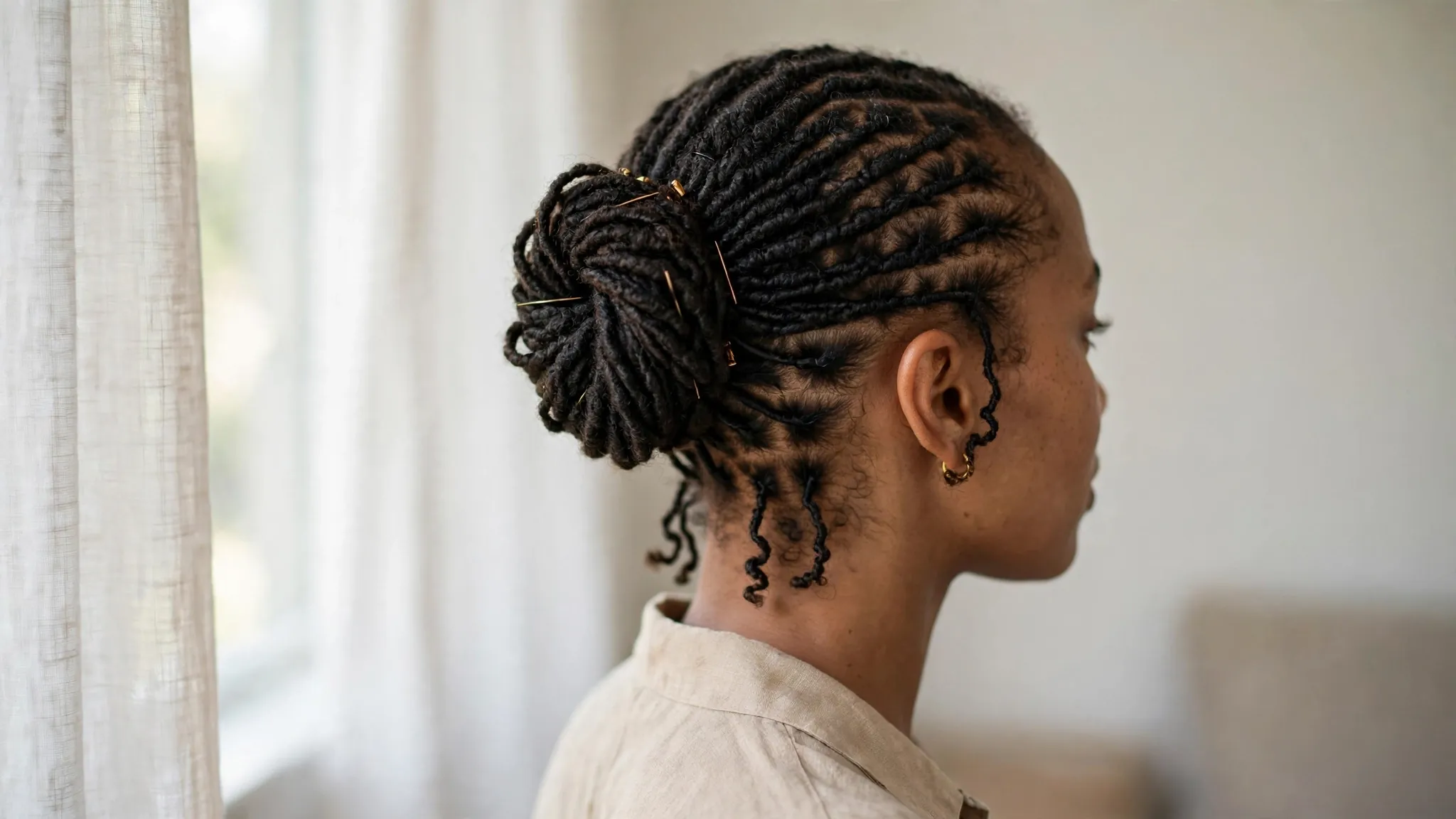
Styling is where micro locs shine, but it is also where people quietly undo their care routine. Because micro locs are small, they can be worn in ponytails, buns, updos, curls, pinned styles, and parted looks that thicker locs cannot always achieve, and that range is a genuine advantage. The risk is not styling itself, it is styling with constant tension, constant pulling, and constant product layering.
A style that looks neat because it is pulled very tight is not a good style for your scalp, no matter how clean it photographs. Rotate styles, give your edges rest, and avoid keeping the same tight ponytail or bun in the same place every day.
When you curl or set micro locs, use methods that do not require heavy product to hold, and let locs dry fully before pinning them tightly, because damp, tightly pinned locs can stay damp longer and feel heavier than they look. Color needs honesty, not just enthusiasm.
Color can look beautiful on micro locs, but it also changes the care equation, because lightening and frequent color work can dry locs and make them more fragile, especially at the ends. If you want color, talk to your loctician about timing, about whether color should happen before or after a retightening cycle, and about how your routine will change afterward. The same logic applies to extensions for length.
Extensions can give immediate length and fullness, but they also add weight, blending work, and maintenance questions that should be discussed before installation, not discovered after. Style micro locs as if you plan to keep them for years, because you do. Choose styles you can repeat without pain, without buildup, and without dreading your next wash day.
The Mistakes That Cost People Their Micro Locs12
Most micro locs problems are not mysterious, they are predictable, and they cluster around a handful of decisions. The first is choosing size from a photo alone, without density, strand thickness, fullness, and maintenance time in the conversation. The second is skipping or delaying retightening, then trying to fix months of new growth in one long, tight session.
The third is using heavy products that promise moisture but deliver buildup, itchiness, and lint attraction in small locs. The fourth is ignoring scalp signals, soreness, bumps, or thinning at the hairline, in the hope that it will settle on its own. The fifth is starting with an uneven grid, or doing a DIY install without a realistic plan for parting consistency.
The sixth is expecting mature locs in the first months and making panicked changes, like combining, cutting, or over-manipulating locs, because starter locs do not look like a finished photo yet. Each mistake has a simple counter-move, and that counter-move is almost always earlier, lighter, and more patient than the fix. Choose size with a consultation and sample locs. Keep a retightening rhythm you can repeat.
Use light, residue-free products and let your scalp tell you what it needs. Speak up about soreness immediately. Treat parting as permanent. Let starter locs grow and settle without constant intervention. None of this is glamorous advice, and none of it photographs as well as a finished style, but it is the advice that keeps micro locs healthy for years.
If you already have micro locs and something feels wrong, start with four checks: when was your last retightening, what products have you layered in the last month, is your scalp sore or calm, and are your roots separating cleanly? Those four answers usually point to the next step more clearly than any new product will.
Who Should Skip Micro Locs For Now13
Saying no for now is not a rejection of micro locs, it is respect for what they require. You should probably skip micro locs for now if you frequently want to change your whole hairstyle, for example wearing straight hair one week, braids the next, and a completely different look the week after, because micro locs are a long-term base, not a rotating install.
You should also wait if your hair is currently very damaged, very thin, or breaking easily, and has not had time to recover, because small locs need a foundation that can support repeated retightening without thinning further. If you are impatient with slow maturing, if you dislike appointments, or if you cannot currently budget or schedule regular retightening, waiting will save you money, time, and hair health.
If you need a style you can take out easily for work, sport, or a life change in the next few months, micro locs are the wrong tool for that season. None of these reasons mean micro locs will never suit you. Hair recovers, schedules change, budgets change, and patience grows with understanding.
A useful alternative in a waiting season is to focus on scalp health, gentle washing, light moisture, and protective loose styles, while you learn about size, grid, and maintenance from a loctician consultation, without committing to installation yet. A consultation, even if you decide not to install, is not wasted time.
It gives you a size, a grid idea, a maintenance estimate, and a realistic picture of cost and time on your own head, which is far more valuable than another hour of scrolling through finished heads online. When you do decide to start, you will start with a plan, not just a photo.
Questions To Ask Before You Book14
Before you book installation, use this checklist in your consultation, and write down the answers for your own head, not for a generic head. What size do you recommend for my density and strand thickness, and why, and can I see sample locs in that size on my hair? What method will you use to start my locs, and what are the trade-offs of that method for my texture?
How long will installation take, and will it be split across sessions? How often will I need retightening, how long will each session take, and what will it cost over time, not just on day one? What washing and product routine do you recommend for my scalp, and what should I avoid in the first months?
How do you handle soreness, bumps, or thinning at the hairline, and what should I do if I notice them between appointments? How do you part and grid, and can I see heads you have maintained for a year or more, not only fresh installs? What happens if some locs need to be combined later, and how would that change the look?
What should I do about lint, buildup, color, and extensions, if I want any of those later? If a loctician answers these questions clearly, with specifics for your hair, that clarity is a good sign. If answers are vague, rushed, or only about price and speed, that vagueness is also information. Take it seriously.
The cheapest or fastest install is not the best install if the grid is uneven, the tension is too high, or the maintenance plan does not fit your life. A good loctician will welcome these questions, because they make the journey smoother for both of you. A loctician who is annoyed by them is telling you something about how future appointments will feel.
- Sample locs in your size, seen on your own hair
- Grid and parting plan you can live with
- Retightening rhythm you can actually keep
- Washing and product routine for your scalp
Frequently Asked Questions About Micro Locs15
What are micro locs?
Micro locs are small locs made from tiny sections of your own hair, started by twisting, braiding, coiling, or interlocking, and left to mat into a long-term style. They look finer and more flexible than traditional locs, and they are not a temporary install you take out at the end of the month.
Are micro locs the same as Sisterlocks?
No. Sisterlocks are a trademarked system with certified consultants, a specific interlocking tool, a precise grid pattern. Micro locs are a broader category with flexible sizing and methods, and they can be installed by any experienced loctician.
How long do micro locs take to install?
Installation time varies widely by density, length, size, and method, and it is often split across sessions. Published salon sources give very different ranges, which is why your own head matters more than any single online number.
How often should micro locs be retightened?
Many salon sources suggest roughly every four to eight weeks, with some suggesting four to six and others six to eight, depending on growth, texture, and method. The key is a rhythm you can keep consistently.
Can I wash micro locs?
Yes, and you should keep your scalp clean. Use a residue-free approach, avoid heavy conditioners and thick products that cause buildup in small locs, and protect locs at night with satin or silk.
Can micro locs be styled like loose hair?
They offer more styling range than thicker locs, including updos, ponytails, curls, and pinned styles, but they are still a long-term base style. Rotate styles and avoid constant tight pulling on the same edges.
Can I remove micro locs?
They are not designed to come out easily. Combing out a full head can take a very long time, and many people choose to cut them instead if they want to end the journey. Treat installation as a long-term decision, not a trial style.
Are micro locs good for thin or damaged hair?
It depends on the cause and current condition of your hair. Very damaged or very thin hair that is breaking easily may not support repeated retightening well, and a consultation is important before starting.
Bottom line: micro locs reward the person who chooses size carefully, keeps a retightening rhythm they can actually repeat, washes lightly, protects locs from lint and buildup, and speaks up about scalp soreness early. They punish rushing, skipping appointments, heavy products, and choosing a look from someone else’s finished photo.
If you start with a consultation, a sample size on your own hair, and an honest maintenance plan, micro locs can be light, flexible, and lasting in a way that feels calm rather than constant. If that rhythm does not fit your life right now, waiting is not a loss.
It is how you protect the hair you will want to loc later, and it is the most practical decision this guide can leave you with.
Your next step is simple: book a consultation, ask for sample locs in your size, and check the retightening rhythm before you commit to installation. That one consultation will tell you more about your own hair than any photo online.
This article is for general informational purposes only. Individual results, hair types, scalp conditions, and situations may vary. For personal hair or scalp concerns, consult a qualified loctician or dermatologist.
