



Faux Locs: A Complete Guide to Crochet, Styles, Care & Removal
-
- October 27, 2026

Faux locs give you the look of locs without the long-term commitment. They are made with added hair, worn for a few weeks, and then taken out, while your own hair underneath stays loose and un-locked.
That simple idea is why so many people choose them, and also why so many people get disappointed. The style is temporary, but the decisions behind it are not small. Method, weight, length, and removal all affect your scalp, your edges, and the health of the hair you take out at the end.
This guide covers crochet faux locs, faux locs hairstyles, and how to do faux locs, in one place, so you can choose well before you sit in the chair.
Quick Decision 01
Use this table first. If most of the “choose this” column sounds like you, faux locs are worth trying. If most of the “skip this” column sounds like you, waiting will save you more than a new style will give you.
| Choose faux locs if | Skip them for now if |
|---|---|
| You want the loc look for weeks, not years, and you like trying a style before committing to it. | Your hair is breaking easily, or your scalp is sore, flaky, or irritated right now. |
| You can keep a gentle wash and drying routine, and you can leave heavy products alone. | You cannot keep locs dry, or you need to wash and restyle your own hair every few days. |
| You want a protective style that gives your own hair a rest from heat and daily styling. | You want real, permanent locs and you are ready for that journey instead. |
Three Decisions Before Anything Else 02
Every good faux locs result comes down to three decisions, and every bad one usually comes down to skipping one of them. The framework is simple: Method, Weight, and Time. Keep it in mind through the whole guide, because each later section is really just one of these decisions in more detail.
Method: how the locs are put in. Crochet faux locs are usually faster, while wrapping each braid by hand is slower but can look more natural up close. Neither method is best for everyone, and the right one depends on your hair, your patience, and your budget.
Weight: how heavy the finished head feels. Length, thickness, and the amount of added hair all add weight. Weight is not just comfort. Heavy locs pull on your edges and your neck, and that pull, day after day, is what causes damage.
Time: how long you will keep them in. Faux locs are meant to come out. Planning the removal date before installation is not pessimistic. It is the part that protects your own hair, and it stops a good protective style from turning into a matted problem.
What Faux Locs Actually Are, And What They Are Not 03
Faux locs are a temporary style that looks like locs. Your own hair is braided or cornrowed first. Cornrows are small braids that lie flat against the scalp. Added hair, usually a soft synthetic fibre, is then wrapped, crocheted, or looped around that base to form each loc.
They are not real locs. Real locs, or dreadlocks, are formed when your own hair mats and locks together over time. Faux locs only imitate that look. When you take them out, your own hair is still loose hair underneath, not locked hair.
That difference is the whole point, and it is also the most common misunderstanding. People sometimes buy faux locs expecting them to turn into real locs if they leave them in long enough. They do not. Leaving them in longer does not start a loc journey. It only increases the chance of matting, build-up, and breakage at the roots.
Faux locs are also not the same as soft locs, although the two are often confused. Soft locs are a softer, lighter type of faux loc, usually with a more relaxed, wavy texture. Our comparison of soft locs vs faux locs explains the five main differences, if you are choosing between those two looks.
Other names you will see mean the same family of styles, not different hairstyles to research separately. Crochet faux locs, crochet dreads, goddess locs, and distressed locs are all faux locs with a different method or finish. Goddess locs usually have loose, curly ends. Distressed locs are made to look intentionally loose and textured, rather than smooth and neat.
Faux Locs vs Real Locs: A Decision, Not A Ranking 04
It does not help to ask which is better in general, because faux locs and real locs solve different problems. One is a short-term style you can remove. The other is a long-term change to your own hair. The right question is simpler: what do you want your hair to be doing in three months?
| Question | Faux locs | Real locs |
|---|---|---|
| How long does it last? | Weeks, then removed. | Years, unless cut or combed out over a long time. |
| What happens to your own hair? | It stays underneath, protected from daily styling, and is revealed again at removal. | It mats and locks itself, and becomes the style. |
| Can you change your mind easily? | Yes, by taking them out. | No, not easily. Ending locs usually means cutting or a very long comb-out. |
| Best for | Trying the look, a holiday or season, or resting your hair. | A long-term style and identity you plan to keep and maintain. |
If you want to test the loc look before committing, faux locs are the honest trial. If you already know you want real locs, read our micro locs guide instead, because it covers size, grid, and the regular retightening rhythm that real locs need.
The myth to drop here is that faux locs are a shortcut to real locs. They are not a shortcut. They are a different tool. Used for a few weeks and removed gently, they can protect your hair. Used as a way to avoid deciding, and left in for months, they can damage the very hair you were trying to protect.
Crochet Faux Locs: How The Crochet Method Works 05
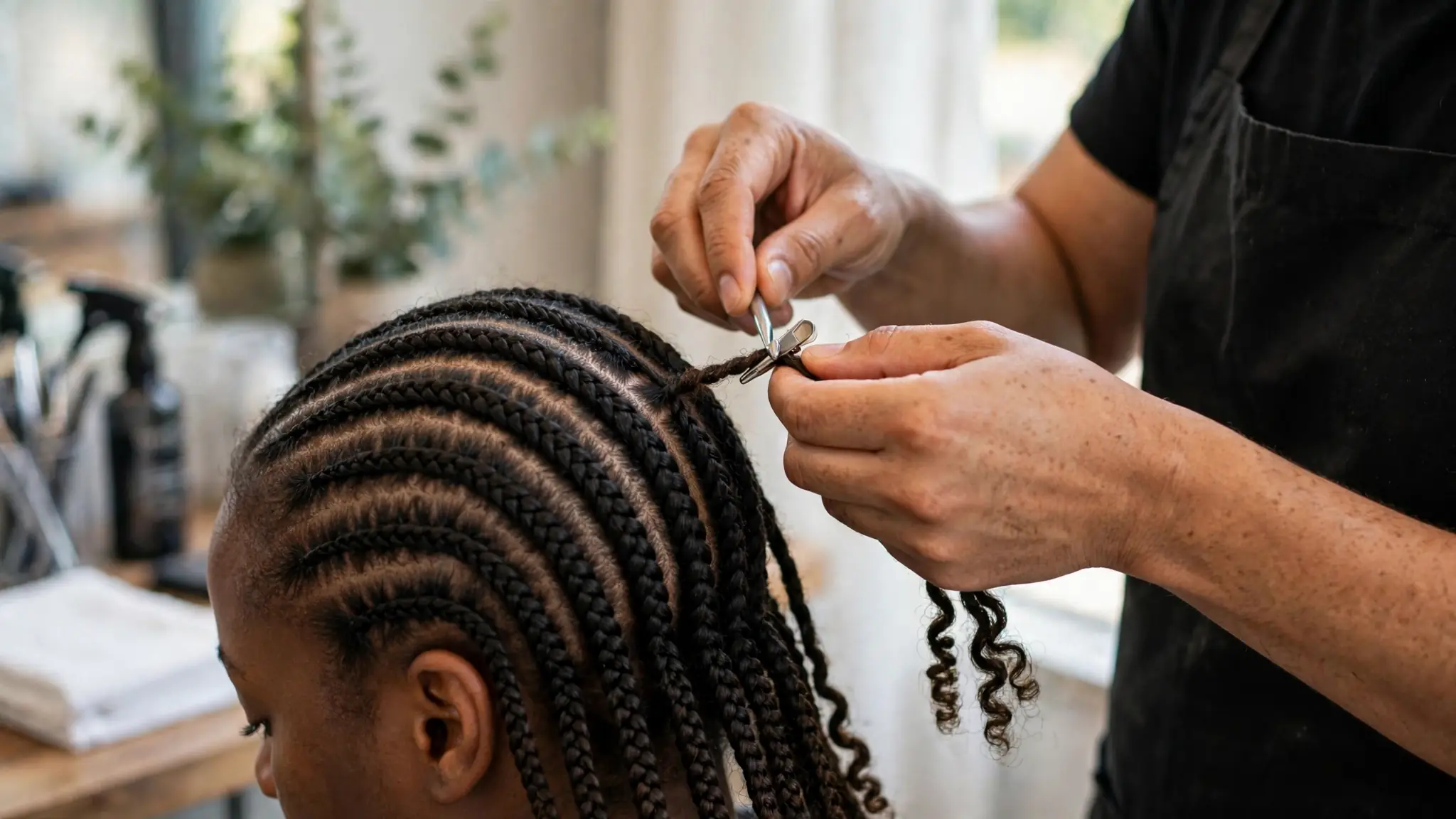
Crochet faux locs are the most popular method today, mainly because they are faster. Your own hair is first braided into cornrows that lie flat against the head. Pre-made locs are then pulled through those cornrows with a small latch hook, sometimes called a crochet hook, and looped so they stay in place.
A latch hook is a small tool with a tiny closing hook at the end. It catches the loop of a pre-made loc, pulls it under a cornrow, and lets the stylist secure it without wrapping every strand by hand. That is why crochet installs are often finished in a few hours, while hand-wrapped installs can take most of a day.
Guides vary on exact install time, which is why no single number is given here as a fact. Crochet installs are often described as taking around two to five hours, depending on length, size, and how many locs are used. Hand-wrapped installs are often described as taking six to eight hours or more. Your own head, your stylist, and your chosen length matter more than any online average.
Crochet faux locs also tend to put less pulling on each small section than wrapping many individual braids, because the weight is shared across a cornrow base. That does not mean they are tension-free. A cornrow that is braided too tightly will still hurt, and it will still pull on your edges, even if the locs themselves were crocheted in gently.
The trade-off is control. With crochet, the locs are pre-made, so you choose from the textures and lengths available. With wrapping, a stylist can shape each loc more freely around your own braids. If you want a very specific, natural-looking finish and you have a full day to sit, wrapping may suit you better. If you want a neat result in less time, crochet is usually the practical choice.
How To Do Faux Locs: The Steps In Order 06
This section explains how to do faux locs in plain order, so you understand what a stylist is doing and what to check at each stage. It is not a substitute for a trained stylist, especially for your first install. A neat base and gentle tension are skills that are hard to judge on your own head, from behind, in a mirror.
- Start clean and moisturised. Wash your hair, detangle gently, and moisturise lightly before the appointment. Heavy creams and thick butters before installation trap build-up under the locs later.
- Choose the base. For crochet faux locs, that base is cornrows. For wrapped faux locs, it is small individual braids. Check that the base is firm but not painful before any added hair goes on.
- Check size and length first. Ask to see one or two locs against your face and shoulders before the full head is done. Changing length after half a head is installed is a waste of time and hair.
- Install gently, section by section. For crochet, each pre-made loc is looped through a cornrow. For wrapping, added hair is wrapped around each braid from root to end, and the end is sealed, often with hot water, if the hair type allows it.
- Check tension before you leave. Move your head, raise your eyebrows, and smile. If your scalp feels tight, if you see small bumps along a part, or if you have a headache, say so at once. Loosening one section now is easy. Repairing an edge later is not.
- Set a removal date. Agree a date, in weeks, not months, to take them out. Write it down. A style without a removal date is how a four-week install becomes a three-month problem.
For the amount of hair, guides often suggest around three to five packs for a full head, depending on length, thickness, and the brand. Treat that as a starting range to discuss with your stylist, not a rule. A very long, full style will need more hair, and more hair means more weight.
If you are thinking of doing faux locs at home, be honest about the base. Cornrowing the back of your own head evenly, without pulling, is the hardest part. Many home installs go wrong there, not in the wrapping or crocheting itself. A professional base, even if you style the locs yourself later, is often the cheaper choice in the long run.
Choosing Length, Size And Hair 07
Length is the decision people enjoy most, and the one they regret most. Longer looks dramatic in photos, but it is heavier, takes longer to dry, and pulls more when you tie it up. Shorter styles, like a bob-length faux loc, are lighter, dry faster, and are often easier to live with for a first install.
| Length | Feels like | Watch out for |
|---|---|---|
| Bob, around shoulder length | Light, easy to wash and dry, good for a first try. | Less styling range than longer locs. |
| Medium, mid-back | A balance of styling choice and manageable weight. | Needs full drying after washing, or it stays damp. |
| Long, waist length or more | Dramatic, with the most updo and braid styling options. | Heaviest on neck and edges, slowest to dry, hardest to sleep on. |
Size matters in the same way. Smaller locs look finer and give more styling detail, but there are more of them, so installation takes longer. Larger locs are faster to install and lighter in count, but they can feel bulky, especially if they are also long. Our dreadlock size chart can help you picture how size changes the finished look.
For hair type, most faux locs use synthetic hair, often made from fibres such as Kanekalon. Kanekalon is a man-made fibre designed to feel soft and look like natural hair, without the cost of human hair.
Human hair blends exist, and they can last longer and feel softer, but they cost more, and cost varies widely by length, brand, stylist, and region, so get a quote for your own head rather than trusting one online price.
One lesser-discussed point is heat. Some synthetic hair can be curled or sealed with hot water, and some cannot. Ask before you buy, and test one loc, not the whole head, if you plan to curl or seal the ends. Melted or stiff ends are very hard to fix once the whole style is finished.
Faux Locs Hairstyles That Actually Work 08

Faux locs hairstyles work best when they change the weight, not just the look. A style that pulls all the locs to one tight point every day will hurt your edges, even if it photographs well. Rotating styles, and giving your hairline rest days, is the real styling secret.
High bun, worn loosely: gather locs up without pulling the front tight, and leave a few face-framing locs out. This is the easiest everyday style, and it keeps locs off your neck in warm weather.
Half-up, half-down: take only the top section up, and leave the rest loose. This gives you an updo look without putting the full weight of the head on one point.
Side part or middle part, worn down: the simplest style, and often the kindest to your scalp, because there is no pulling at all. Use it on rest days between tighter styles.
Low ponytail or low bun: a softer choice than a high, tight ponytail, because the weight sits lower and pulls less on the front hairline. Avoid tying it in exactly the same place every day.
Braided crown or twisted front sections: braid or twist just the front locs back, and leave the rest loose. This keeps hair out of your face without a tight, all-over pull.
Accessories can help, but they can also hurt. Light scarves, beads, and cuffs that sit on the locs are usually fine. Tight headbands, heavy clips, and elastic bands that grip the same spot every day are not. If an accessory leaves a dent, a sore spot, or a headache, it is too tight, however good it looks.
For a yarn-based faux look, which is a different, lighter take on the same idea, see our yarn dreads guide. Yarn is softer and often cheaper, but it behaves differently when wet, so do not assume the care routine in this guide transfers exactly to yarn.
How Long Faux Locs Last, And When To Take Them Out 09
Here is the honest answer, and it is not one number. Sources vary widely on how long faux locs last, and that variation is itself useful information. Many guides suggest around four to eight weeks with good care. Some suggest four to six weeks. Others say a well-kept crochet install can last up to ten or twelve weeks, and human hair blends are sometimes described as lasting longer still.
Do not pick the longest number and treat it as a target. The right wear time for you depends on your hair growth, your scalp, the method, and how well you wash and dry the style. Fast growth means new hair at the roots sooner, which means more matting risk if you wait. A sensitive scalp means build-up will bother you sooner, even if the locs still look neat from the outside.
Take them out sooner, whatever the calendar says, if you notice any of these signs. Itching that does not settle after a gentle scalp wash. A smell that stays after drying fully. Roots that are matting together and will not separate gently. Thinning, soreness, or small bumps along your hairline. Dry, breaking hair at the ends, even after moisturising.
The myth to check here is that longer wear means better value. It does not. A style kept in two weeks too long can cost you months of recovery for your own hair. A style removed on time, with your own hair still healthy underneath, is the best value, even if you paid the same install price as someone who kept theirs in longer.
Cost works the same way. Install prices vary widely by method, length, stylist, and region, and no single price in this guide would be honest for every reader. Ask for the full cost, including removal help if you need it, before you book, so the removal decision is not pushed back for money reasons later.
Your Faux Locs Timeline 10
Day 1: The Tightness Test
Day one should feel neat, not painful. Check tension in the chair, as described earlier, and again at home that evening, once the excitement has worn off. A little awareness of new weight is normal. Pain, throbbing, or a headache is not, and it should be loosened, not endured.
First Weeks: Learning The Routine
In the first weeks, you are learning how the style behaves. Some frizz is normal, especially with distressed or goddess finishes. Focus on the basics: keep your scalp clean, keep locs dry after washing, sleep on satin, and rotate styles so no one spot takes all the pull.
Around Week 4 To 6: The Decision Point
Around week four to six, most people reach a decision point, whether they planned one or not. New growth is visible, the style may feel heavier, and washing takes more care. This is the time to judge honestly, by scalp comfort and root condition, not by how the style looks in a photo.
Removal Week: Plan It, Do Not Postpone It
Removal week should be planned like installation week. Book time, gather gentle products, and do not rush it the night before an event. A calm, slow removal protects your hair far more than any product you buy afterwards, and it is where most breakage is either caused or avoided.
Washing, Scalp Care And Everyday Care 11

Washing faux locs is different from washing loose hair, because the goal is a clean scalp, not clean locs. Wash the scalp, and let the rinse water run gently over the locs. Scrubbing the locs themselves, twisting them while wet, or piling them on top of your head to wash will cause frizz and tangling.
A simple method works well for most people. Mix a small amount of mild shampoo with water in an applicator bottle or spray bottle. Apply it mainly to your scalp, along the parts. Massage gently with your fingertips, not your nails. Rinse slowly, and let the water carry the shampoo down the locs without rubbing them together.
Drying matters as much as washing, and this is a point most short guides skip. Faux locs, especially long ones, hold water for a long time. Locs left damp, tied up, or covered while still wet can develop a musty smell, and damp hair underneath is weaker and easier to break. Air-dry fully, in loose sections, before tying locs up or going to sleep.
For products, less is genuinely more. A light oil on your scalp, only if your scalp feels dry, is usually enough. Heavy butters, thick creams, and layered styling products build up on synthetic hair, attract lint and dust, and make the style look dull. If a product leaves a white or sticky film on a loc, stop using it on the locs, even if it works well on loose hair.
At night, protect the style the same way you would protect any braided style. A satin bonnet, a silk or satin scarf, or a satin pillowcase reduces friction, frizz, and lint. Cotton pillowcases rub against locs all night, and that rubbing is one of the quietest causes of frizz and breakage over a few weeks.
For a simple wash routine in more detail, see our guide to washing dreadlocks at home. The principles are the same, even though faux locs come out at the end: clean scalp, gentle handling, light products, and full drying.
What Most Articles Miss 12
Most faux locs articles stop at styles and washing. Three lesser-discussed points deserve more space, because they are where real damage usually happens, quietly, while the style still looks good from the front.
The hidden base: with crochet faux locs, the cornrow base is hidden under the locs, so problems there are easy to miss. A cornrow that is too tight, or a section that is pulling, does not show as clearly as a tight individual braid would. Check your scalp by feel, not just by mirror, and check the nape and edges, where tension is often worst and least visible.
The damp-loc problem: many people wash faux locs correctly, but dry them wrong. They wash at night, tie damp locs up, and sleep on them. By morning, the outside feels dry and the inside is still damp. Over weeks, that pattern causes smell, itch, and weaker hair underneath. Wash earlier in the day, when you have time to dry fully, whenever you can.
The removal trap: articles often treat removal as an afterthought, but removal is where the most breakage happens. People rush, pull matted sections, or cut through their own hair while trying to cut a tight loc. A slow removal, with patience for tangled roots, protects more hair than any deep conditioner used afterwards.
There is also a scalp warning that needs plain language. Hairstyles that pull can lead to hair loss, especially when the pulling is constant and in the same place. That risk is not a reason to fear every braided style. It is a reason to treat pain, bumps, and thinning as stop signals, not as a normal price for beauty.
The Mistakes That Cost People Their Hair Underneath 13
Most faux locs damage is predictable, and it clusters around a handful of decisions. The first is installing on hair that is already damaged or breaking, without giving it time to recover first. Added hair does not heal weak hair. It only hides it, while adding weight.
The second is too much tension, either from a tight base, a tight style, or both. Tension damage rarely appears on day one. It appears as soreness, then bumps, then thinning, and by the time thinning is visible, the damage has been building for weeks. Early soreness is the warning, not a badge of a neat install.
The third is leaving locs in too long, because they still look good. Looks are a poor guide here, because the roots and scalp underneath tell the real story. If roots are matting, if build-up will not wash out gently, or if your scalp is unhappy, the style has done its job and should come out.
The fourth is heavy products and poor drying, covered above, but worth repeating because it is so common. A shelf full of products does not equal care. A clean scalp, light moisture, and fully dry locs do more than any combination of creams and sprays.
The fifth is rushing removal. Pulling, tearing, or cutting without checking what is loc and what is your own hair causes breakage that could have been avoided with an extra hour of patience. If a section will not come apart gently, stop, moisturise it, and work on it slowly, or ask your stylist for help.
Removal Without Breakage 14
Removal should be slow, section by section, and it should start with patience, not scissors. Work on one loc at a time. Unravel or unloop it gently from the end towards the root, and separate your own hair from the added hair as you go. Do not pull a whole section out at once.
For crochet faux locs, that usually means unlooping each loc from its cornrow, then unbraiding the cornrow underneath. For wrapped faux locs, it means unwrapping the added hair from each braid, then unbraiding your own hair. In both cases, the added hair comes off first, and your own hair is dealt with last, gently.
Cut only when you must, and cut only added hair. If a section is so matted that it will not separate, and you are sure it is added hair, a careful cut can save time. If you are not sure what is added hair and what is your own hair, do not cut. Moisturise the section, work it apart slowly with your fingers, and get help if it will not move.
After removal, your own hair will need care, but it does not need punishment. Wash gently, detangle slowly from ends to roots, and deep condition if your hair feels dry. Some shedding is normal, because hair that would have shed daily was held in place by the style for weeks.
A large amount of breakage, with short pieces rather than full shed hairs, is a sign to be gentler next time, and to shorten wear time.
Give your hair a rest before the next install. A break of at least a week or two, with loose, low-manipulation styles, lets your scalp recover and lets you see how your hair really is, without added hair hiding it. Installing a new set the same day you remove an old set, especially if your scalp is sore, is asking for trouble.
Who Should Skip Faux Locs For Now 15
Saying no for now is not a rejection of faux locs. It is respect for what they ask of your hair. You should probably skip them for now if your hair is currently very damaged, very thin, or breaking easily, and has not had time to recover. Small, repeated pulling on weak hair will make it weaker, not stronger.
You should also wait if you have a scalp condition, sores, or irritation that has not been checked. A protective style over an unhappy scalp does not protect it. It hides it, while build-up and dampness make it harder to treat. Get the scalp calm first, then choose a style.
If you cannot keep a wash and drying routine, or you need to wash and restyle your own hair every few days for work or sport, faux locs will frustrate you. They are a low daily effort style, but they are not a no-effort style, and they punish dampness and heavy products more than loose hair does.
If you actually want real, permanent locs, and you are ready for that commitment, faux locs may only delay the decision. A trial is useful if you are unsure. If you are sure, start the real journey properly, with a consultation, rather than spending weeks in a temporary style that does not move you forward.
None of these reasons mean faux locs will never suit you. Hair recovers, scalps calm down, schedules change, and a consultation, even if you decide not to install yet, is not wasted time. It gives you a method, a length, a weight, and a realistic cost for your own head, which is far more useful than another hour of scrolling through finished photos.
Questions To Ask Before You Book 16
Use this checklist in your consultation, and write down the answers for your own head, not for a generic head. What method do you recommend for my hair, crochet or wrapping, and why? What length and size will suit my hair density and my neck, not just a photo?
How long will installation take, and how much will it cost in total, including removal help if I need it? What hair will you use, how many packs, and can it be curled or sealed with hot water? How should I wash and dry this style, and what products should I avoid?
How do you handle soreness, bumps, or thinning at the hairline, and what should I do if I notice them between appointments? When should I plan to take these locs out, and how will removal work? If a stylist answers clearly, with specifics for your hair, that clarity is a good sign.
If answers are vague, rushed, or only about price and speed, that vagueness is also information. The cheapest or fastest install is not the best install if the base is too tight, the weight is too heavy, or the removal plan does not exist. A good stylist will welcome these questions, because they make the whole wear smoother for both of you.
- Method chosen for your hair, not just for speed
- Length and weight you can live with for weeks
- Wash and drying routine you can actually keep
- Removal date agreed before installation starts
Frequently Asked Questions About Faux Locs 17
What are faux locs?
Faux locs are a temporary style that looks like locs, made by wrapping or crocheting added hair around your own braided or cornrowed hair. Your own hair underneath stays loose, and the style is removed after a few weeks.
What are crochet faux locs?
Crochet faux locs are faux locs installed with a latch hook. Your hair is braided into cornrows first, then pre-made locs are looped through those cornrows. This method is usually faster than wrapping each braid by hand.
How long do faux locs last?
Guides vary, with many suggesting around four to eight weeks with good care, and some suggesting longer for certain methods or hair types. Judge by your scalp, roots, and comfort, not by the longest number you find online, and take them out when the signs in this guide appear.
Can I wash faux locs?
Yes, but wash your scalp, not the locs themselves. Use diluted mild shampoo on the scalp, rinse gently, and dry fully before tying locs up or sleeping on them. Damp locs left tied up can develop a musty smell and weaken the hair underneath.
Are faux locs a protective style?
Yes, when they are installed gently, kept clean and dry, and removed on time. They protect your own hair from daily heat and styling. They stop being protective when they are too tight, too heavy, left in too long, or removed roughly. See also our guide to protective styles for locs for the wider picture.
Can faux locs damage my hair?
They can, mainly through tension, weight, poor drying, heavy products, or rushed removal. Pain, bumps, thinning, or soreness are warning signs, not normal side effects. Loosen the style, or take it out, and do not wait for damage to become visible before acting.
How do I take faux locs out?
Work slowly, one loc at a time, from end towards root. Remove the added hair first, then unbraid your own hair gently. Cut only added hair, and only when you are sure what it is. After removal, wash gently, detangle slowly, and give your hair a rest before the next install.
Are faux locs the same as soft locs?
No, although they are related. Soft locs are a softer, lighter type of faux loc with a more relaxed texture. Faux locs is the wider family, and soft locs are one style inside it. Our soft locs vs faux locs comparison explains the differences in detail.
Bottom Line: Your One Next Step 18
Faux locs reward the person who chooses method, weight, and time before installation, keeps the scalp clean and the locs fully dry, and removes the style on time, gently. They punish rushing, tight bases, heavy products, damp locs, and removal done in a hurry.
Your one next step is simple, and you can do it this week. Book a consultation, not an installation, and take the Faux Check list above with you. Ask for a method, a length, and a removal date for your own head, and see one or two locs against your face before you commit to a full head.
If that consultation feels clear, gentle, and specific to your hair, faux locs can be a light, flexible, and genuinely protective few weeks. If it feels rushed, vague, or painful, waiting is not a loss. It is how you protect the hair you will want to style later, and it is the most practical decision this guide can leave you with.
This article is for general informational purposes only. Individual results, hair types, scalp conditions, and situations may vary. For personal hair or scalp concerns, consult a qualified stylist, loctician, or dermatologist.
