



28 Cute Children’s Braids: Easy Kids Braids for School & Play
-
- November 27, 2026

Finding cute children’s braids that work on a real school morning is harder than it looks. A style can be lovely in a photo and a disaster by lunch: too tight at the temples, too heavy on a small head, or too fussy for a child who wants to run to the playground. This guide is for parents who want braids for kids that look sweet, feel comfortable, and survive a normal day.
Inside are 28 kids braids in five groups: easy everyday braids, box braids and cornrows, braids with beads and bows, ponytails and puffs, and gentle toddler styles. Each style has rough install and wear times, a tension rating, and one practical tip, so you can match the style to your child’s age, hair type, and patience.
One rule runs through the whole guide: if a braid hurts, it is too tight. A child’s scalp is still developing, and tight braids can damage the hairline over time. The American Academy of Dermatology notes that hairstyles that pull can lead to hair loss, so comfort always comes before neatness.
Key Takeaways: Kids Braids in One Glance
- A kid-friendly braid is loose at the hairline, light in weight, and quick enough for a child to sit through.
- Simple braids take about 10 to 20 minutes; cornrows about 30 to 90 minutes; full box braids about 2 to 4 hours.
- Most kids braids last about 1 to 4 weeks, depending on the style, activity, and nightly care.
- Beads should be light, firmly secured, and kept away from very young children who may put them in their mouth.
- Golden rule: if your child complains of pain, or you see bumps, redness, or itching, take the braids down the same day.
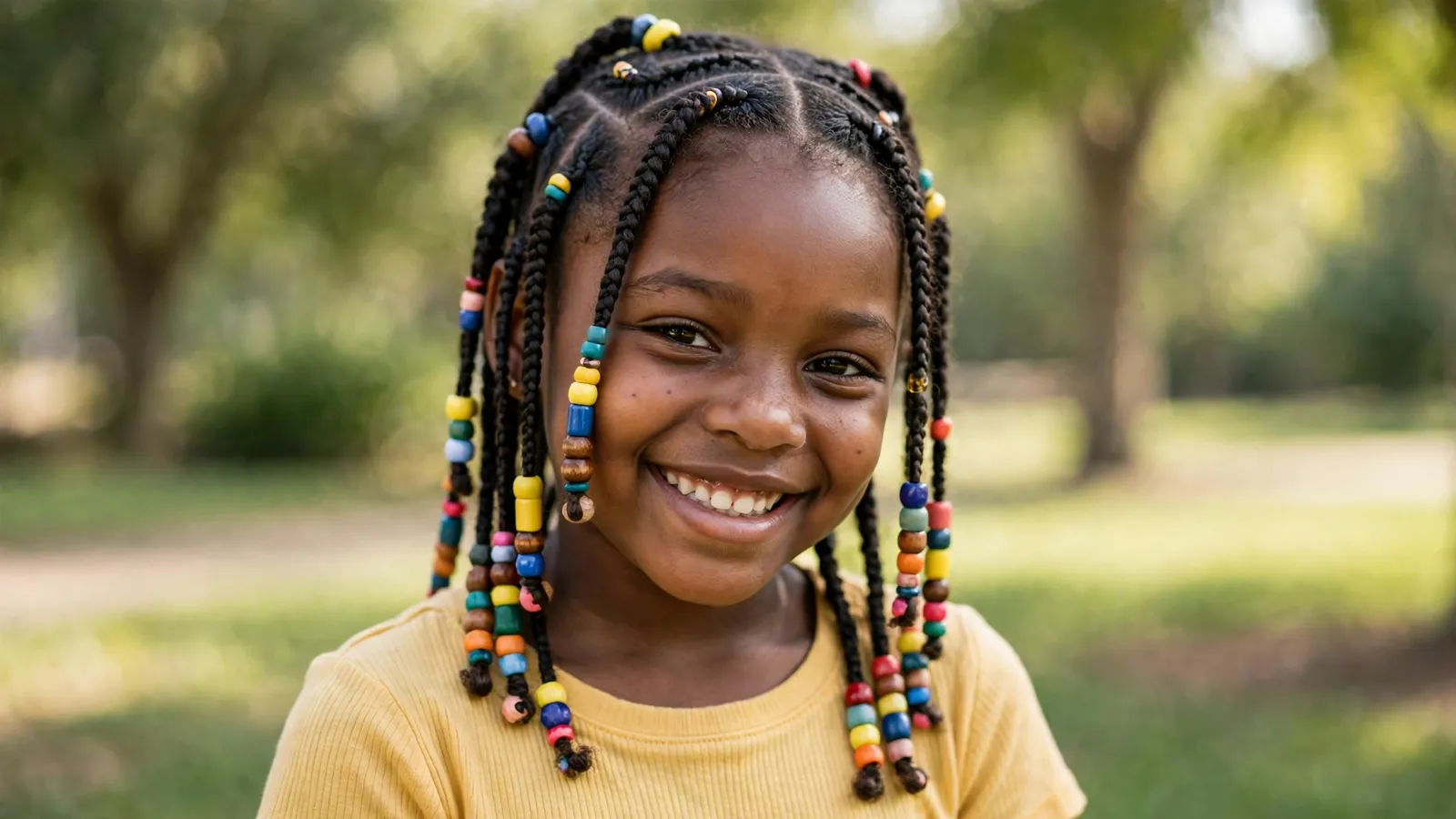
At a Glance: Kids Braid Styles Compared 01
Use this table to narrow the list fast. Times and wear lengths are rough ranges only; they change with hair length, thickness, and how active your child is.
| Style family | Best ages | Install (rough) | Lasts (rough) | Tension |
|---|---|---|---|---|
| Easy everyday braids | 3 and up | 10 to 20 minutes | 1 day | Low |
| Cornrows | 4 and up | 30 to 90 minutes | 1 to 2 weeks | Low to medium |
| Box braids and knotless braids | 5 and up | 2 to 4 hours | 3 to 6 weeks | Low to medium |
| Braids with beads and bows | 4 and up | 30 minutes to 2 hours | 1 to 3 weeks | Low to medium |
| Braided ponytails and puffs | 3 and up | 15 to 45 minutes | 1 day to 1 week | Low |
| Toddler-friendly styles | 2 to 4 | 10 to 30 minutes | 1 to 5 days | Low |
What Makes a Braid Kid-Friendly? 02
A braid is kid-friendly when it passes four tests. First, tension: the hairline should lie flat and calm, with no pulling, bumps, or pain. If your child keeps scratching at the temples after styling, the braids are too tight, even if they look neat.
Second, time in the chair: young children rarely sit still for hours, so save long installs for older kids or split them into two short sessions. Third, weight: heavy extension hair and big bead clusters tire a young scalp, so keep added hair light and beads near the ends. Fourth, daily life: a good kids braid survives school, sports, and sleep without constant fixing.
Easy Everyday Braids for Kids 03
These are the braids to learn first. They take minutes, need no salon visit, and suit school days, sports, and playdates. Most work on straight, wavy, and lightly textured hair, and they come out the same night.
1. Classic French Braid
The first braid most parents learn, and it still earns its place. It sits flat against the head, gathers loose layers as you go, and keeps the back neat without clips. Our full French braid guide walks through each step.
Quick facts: Install: about 10 to 15 minutes · Lasts: 1 day · Tension: Low
Tip: Braid looser at the front and firmer near the nape, so the hairline stays comfortable.
2. Sleek Dutch Braid
A Dutch braid is a French braid in reverse: cross the sections under instead of over, and the braid stands up in a raised, rope-like line. Kids who like a bolder look often prefer it. See our Dutch braid guide for the method.
Quick facts: Install: about 10 to 15 minutes · Lasts: 1 day · Tension: Low
Tip: Practise the under-cross on a doll first; the hand motion feels strange at first.
3. Twin French Pigtails
Two French braids, one on each side of a centre part. They balance the face, keep hair controlled on both sides, and hold up through running, climbing, and sports practice. This is the style many parents reach for on busy mornings.
Quick facts: Install: about 15 to 20 minutes · Lasts: 1 day · Tension: Low
Tip: Count your crosses on the first side so the second side matches in length.
4. Twin Dutch Pigtails
The same two-sided shape as French pigtails, but the braids pop out from the head instead of lying flat. The raised pattern looks sporty and neat, and it stays visible even on thick or textured hair.
Quick facts: Install: about 15 to 20 minutes · Lasts: 1 day · Tension: Low
Tip: On slippery hair, a little styling cream on the mid-lengths helps strands stay put.
5. Fishtail Side Braid
A fishtail uses just two sections, taking tiny pieces from the outside of each one and crossing them over. The result is a fine, woven texture that looks far fancier than it is. Swept over one shoulder, it keeps the braid visible from the front.
Quick facts: Install: about 15 to 25 minutes · Lasts: 1 day · Tension: Low
Tip: Keep the sections tiny and even; large pieces make the fishtail look chunky.
6. Rope-Twist Pigtails
Split each section into two strands, twist them in one direction, then wrap them around each other in the opposite direction. That is the whole technique. It suits younger kids because it is easier than a three-strand braid and stays neat on shorter hair.
Quick facts: Install: about 10 minutes · Lasts: 1 day · Tension: Low
Tip: Twist both strands the same way, then wrap the opposite way, or the rope unravels.
Box Braids and Cornrows for Kids 04
Cornrows and box braids are the long-wear protective styles in this guide. They keep curly and coily hair tucked away, cut daily styling time, and can last one to several weeks. They need the most care with tension, so never let a braider pull hard at the edges.
7. Straight-Back Cornrows
The classic starting point for kids. Rows run in straight lines from the forehead to the nape, braided flat against the scalp. They keep hair out of the way, which makes them ideal for school, sports, and swimming.
A stylist braids neat kids cornrows with beads and bows. Post: @slaynattraction on Instagram
Quick facts: Install: about 30 to 60 minutes · Lasts: 1 to 2 weeks · Tension: Low to medium
Tip: Start with four to six wide rows for a first set; fewer rows mean a shorter session.
8. Zigzag Cornrows
The same flat, durable base as straight rows, but the parts wind in gentle zigzags. Kids ask for this one again, because the pattern looks playful without any accessories, and the angled parts hide new growth fuzz a little longer.
Quick facts: Install: about 45 to 90 minutes · Lasts: 1 to 2 weeks · Tension: Low to medium
Tip: Draw the whole zigzag pattern with the comb tip before braiding, so lines stay even.
9. Heart-Shaped Cornrows
A heart is drawn at the front of the head, its outline braided close to the scalp, and the rest of the hair braided straight back. It is a sweet choice for birthdays, picture day, and holidays.
Quick facts: Install: about 45 to 90 minutes · Lasts: 1 to 2 weeks · Tension: Low to medium
Tip: Keep the heart small and the surrounding rows simple, so the shape stays clear.
10. Jumbo Cornrows
Thick sections mean a fast install, so jumbo cornrows suit kids who dislike long sessions. Wide rows mean fewer braids, less time in the chair, and less fuss. Keep the length at shoulder level, since thick braids get heavy quickly.
Quick facts: Install: about 30 to 45 minutes · Lasts: 1 to 2 weeks · Tension: Low
Tip: A good first cornrow style for a child who has never sat for braids before.
11. Kids Box Braids
Neat, square-parted braids that hang free and last longer than cornrows. They can be styled into ponytails and buns, and they cut morning styling to a few minutes. For children, keep sections smaller than an adult would wear, with light, short-to-medium length. See our box braids guide.
Quick facts: Install: about 2 to 4 hours · Lasts: 3 to 6 weeks · Tension: Low to medium
Tip: Book box braids for a weekend or school break, with snack and screen breaks.
12. Knotless Braids for Kids
Knotless braids feel gentler than classic box braids. They start with the child’s natural hair and feed extension hair in gradually, so there is no tight knot at the root pulling on the hairline. See our knotless braids styles for boho and bob variations.
Quick facts: Install: about 2 to 4 hours · Lasts: 3 to 5 weeks · Tension: Low
Tip: Ask the braider to start the feed-in a little behind the hairline, never on the edges.
13. Jumbo Knotless Braids
Large square sections install much faster than small knotless braids, so they suit kids who dislike long salon visits. Fewer braids also mean less pull on the scalp and a faster take-down, which children appreciate just as much.
Quick facts: Install: about 1 to 2 hours · Lasts: 2 to 4 weeks · Tension: Low
Tip: Keep the length moderate; large braids get heavy fast.
14. Lemonade Braids for Kids
Long cornrows swept to one side, falling over the shoulder. The side-swept shape looks elegant for parties and photos, and it has become a firm favourite with older kids. Keep extension hair at shoulder length so the braids stay light during play.
Quick facts: Install: about 1 to 4 hours · Lasts: 2 to 4 weeks · Tension: Low to medium
Tip: A satin scarf at night keeps the side-swept shape neat into week three.
15. Fulani Braids for Kids
Fulani braids mix cornrows with loose hanging braids, often finished with beads or cuffs. The classic pattern has a centre braid with side cornrows and decorated ends. Keep it simple for kids: one centre row, a few side rows, light beads on the ends. Our Fulani braids styles guide shows the full range.
Quick facts: Install: about 2 to 4 hours · Lasts: 2 to 4 weeks · Tension: Low to medium
Tip: Most braiders suggest waiting until around age 5 or 6 for a full Fulani install.
16. Stitch Braids for Kids
Stitch braids show crisp, even lines along each row, almost like stitching. The look is sharp and tidy, which makes it popular for school photos and special events. It needs a steady hand, so it is usually a salon job rather than a first at-home try.
Quick facts: Install: about 1 to 3 hours · Lasts: 2 to 3 weeks · Tension: Medium
Tip: Stitch braids look best on freshly washed, stretched hair, so plan wash day for the same morning.
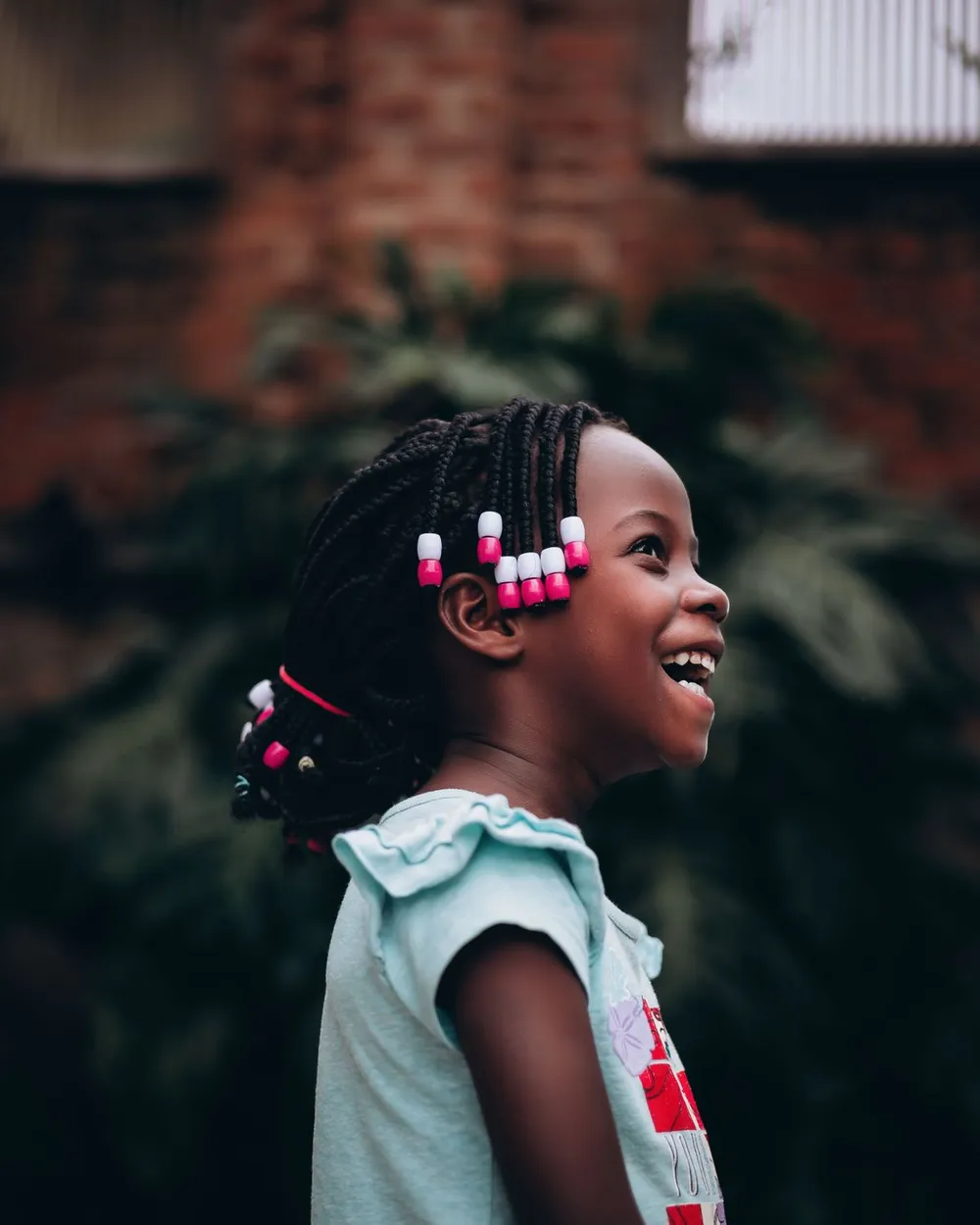
Photo: zeck on Pexels
Braids with Beads and Bows 05
Beads, bows, and ribbons turn a simple braid into a style a child gets excited about. Keep beads light and firmly secured, and remember the safety rules: no small loose beads for toddlers, and beads off before bed for very young children.
17. Cornrows with Beaded Ends
The simplest beaded style, and often the best first one. Neat rows run straight back, and each braid ends with a small cluster of beads in colours your child picks. Keep beads on the lower half of the braid so they do not tug at the roots.
A toddler shows off small braids with yellow and pink beads. Post: @phil_wright_ on Instagram
Quick facts: Install: about 30 to 60 minutes · Lasts: 1 to 2 weeks · Tension: Low to medium
Tip: Load all the beads onto a thread before you start; the beading step goes twice as fast.
18. Beaded Box Braids
The classic party look for kids: square-parted braids with beads swinging at the ends. They bring movement and colour, and kids usually notice that part right away. Keep bead placement balanced, since too many beads on one side makes the hair pull unevenly.
Quick facts: Install: about 2 to 4 hours · Lasts: 3 to 5 weeks · Tension: Low to medium
Tip: Beads on the front and back rows only give the same effect with half the weight.
19. Twin Braids with Matching Beads
Two braids, one on each side, finished with the same bead pattern on both ends. The matching colours make the style look finished, and children love picking the colour scheme. Two-colour alternation is the easiest pattern: pick two colours and repeat them down each braid.
Quick facts: Install: about 20 to 30 minutes · Lasts: 1 day to 1 week · Tension: Low
Tip: Let your child lay out the bead pattern on a table first; it keeps them busy.
20. Beaded Braided Pigtails
Pigtails plus beads: the braids keep hair controlled on both sides, and the beads add a playful finish for birthdays and school photos. Secure every bead with a small band so it stays on through play, and check the beads nightly for cracks.
Freestyle braided ponytails with ombre beads and a red bow. Post: @dtb.k__braids on Instagram
Quick facts: Install: about 20 to 30 minutes · Lasts: 1 day to 1 week · Tension: Low
Tip: Use slightly larger beads for pigtails, since small beads slide off during play.
21. Braids with Bows and Ribbons
Bows and ribbons are the soft alternative to beads, and they suit children who find beads too heavy or noisy. A satin ribbon woven through a braid adds colour at once, and you can match it to a dress or school colour without changing the braid itself.
Neat cornrows gathered into pigtails with big bows and beaded ends. Post: @aphricanace on Instagram
Quick facts: Install: about 15 to 30 minutes · Lasts: 1 day to 1 week · Tension: Low
Tip: Satin ribbon slides nicely; stiff craft ribbon catches and pulls, so avoid it.
22. Rainbow Bead Ends
Braids finished with beads in every colour of the rainbow. They are loud, joyful, and very popular for birthdays, festivals, and summer holidays. An ombre effect also works well: start darker near the braid and get lighter toward the tip.
A gallery of creative beaded braid styles for little girls. Post: @letstalkhairs2 on Instagram
Quick facts: Install: about 30 minutes to 2 hours · Lasts: 1 to 3 weeks · Tension: Low to medium
Tip: Buy beads in mixed rainbow packs; buying colours one by one costs more.
Braided Ponytails and Puffs 06
Ponytails and puffs are the playground-proof styles. They keep hair off the neck, stay put all day, and take minutes to build. Most work on short to medium hair, and they are easy to refresh in the morning.
23. Braided High Ponytail
Tie a high ponytail, divide it into three sections, and braid down to the ends. The braid keeps the tail from tangling, and a small braid wrapped around the base hides the elastic. A strong pick for sports and dance. See our plait ponytail ideas for more.
Quick facts: Install: about 10 to 15 minutes · Lasts: 1 day · Tension: Low
Tip: Use a soft scrunchie under the braid at the base; a hard elastic feels bulky.
24. Cornrows into a Braided Bun
Rows lie close to the scalp, and the bun gathers the ends into one clean point. On coily or tightly textured hair, this style can hold well for days when done gently. Keep the bun low enough that it does not poke your child when she leans back.
Quick facts: Install: about 45 to 60 minutes · Lasts: 1 week · Tension: Low to medium
Tip: Crisp, even rows make the bun look tidy; uneven spacing throws the whole style off.
25. Braided Space Buns
Two braids rise into buns on either side of the head, giving a lively, balanced look. It is playful without being messy, which suits school and parties. The buns must sit at the same height, or the imbalance shows right away.
Quick facts: Install: about 20 to 30 minutes · Lasts: 1 day · Tension: Low
Tip: Tuck the braid ends fully into the buns; loose ends make the buns wobble.
26. Cornrows with Two Puffs
The front or sides are cornrowed, and the top is styled into two soft puffs. It is cheerful, comfortable, and works well on shorter hair that cannot hold a long braid. The puffs can be refreshed each morning with water and a little curl cream.
Quick facts: Install: about 30 to 45 minutes · Lasts: 3 to 5 days · Tension: Low
Tip: Keep the puffs soft and loose; tight puffs strain the hairline like tight braids.
Toddler-Friendly Braid Styles 07
Toddlers need the gentlest, shortest styles of all. Their hair is fine, their scalps are tender, and their patience runs out fast. Keep every toddler style loose, quick, and light, and skip beads for children who still put small objects in their mouth.
27. Two Loose Braids for Toddlers
The safest starting point for a toddler’s first braids. The hair is parted down the middle and braided loosely on each side, with soft elastics at the ends. Nothing pulls at the hairline, and the whole style takes about ten minutes.
A mum braids her toddler’s hair with loose sections and beads, step by step. Post: @tatted_tatti on Instagram
Quick facts: Install: about 10 minutes · Lasts: 1 to 3 days · Tension: Low
Tip: If your toddler will not sit still, braid one side, take a play break, then do the other.
28. Mini Puffs with Tiny Braids
A gentle way to style short toddler hair that is too short for full braids. Small sections at the front are braided back a few inches, and the rest of the hair is gathered into one or two soft puffs. It also works for boys with short textured hair.
Quick facts: Install: about 15 minutes · Lasts: 1 to 3 days · Tension: Low
Tip: On very short hair, two small front braids are enough; braiding the whole head frustrates you both.
What You Need to Braid Kids’ Hair 08
You do not need a salon kit. A wide-tooth comb for detangling, a rat-tail comb for clean parts, soft snag-free elastics, a spray bottle of water, and a light leave-in conditioner cover nearly every style here.
For beaded styles, add a bead threader and light plastic or silicone beads. Patch-test any new product on a small patch of skin first. If you also want gentle twist options, our twist hairstyles guide shows styles that suit kids too.
How to Braid Kids’ Hair Step by Step 09
Start with clean, detangled hair. Wash and condition first, apply a light leave-in, and detangle gently from the ends upward with a wide-tooth comb. Never braid dry, tangled hair; it hurts, it breaks, and the parts come out uneven.
Part the hair for your chosen style, clip away the sections you are not working on, and mist lightly as you go. Braid with a steady, gentle rhythm, adding small sections evenly. Finish with a soft elastic, add beads or bows if the style calls for them, then do the comfort check: ask your child to move their head and tell you honestly if anything pulls.
Time, Cost and How Long Kids Braids Last 10
At home, simple braids cost nothing but time: about 10 to 20 minutes for everyday styles, and 30 to 90 minutes for cornrows. Salon prices vary widely by city, style, and braider, so ask your local braider for a quote and confirm whether beads and added hair are included.
Simple braids last a day. Cornrows usually last about 1 to 2 weeks on kids, since children play hard and often sleep without a bonnet. Box braids and knotless braids on older kids can last about 3 to 6 weeks with good care. The American Academy of Dermatology advises keeping braids in for no longer than 6 to 8 weeks at most, and younger children, fine hair, or any discomfort call for earlier removal.
Are Braids Right for Your Child? 11
Age matters more than the style itself. Toddlers do best with two loose braids or simple cornrows that take minutes and put no strain on a developing scalp. School-age children from about 5 can handle cornrows and beaded styles, and older kids from about 9 can sit through box braids. There is no strict minimum age, but the hair should be long enough to braid without pulling.
Hair type matters too. Fine hair slips easily, so smaller sections and a little styling cream help braids hold. Thick or coily hair needs moisture and clean parts to stay neat. Braids suit boys as well as girls; straight-back cornrows and box braids are popular with boys, and the same tension rules apply. Check school rules before a big install, since some schools limit bead size, hair colour, or accessories.
Kids Braid Care Timeline 12
Night one: Check the hairline for redness, bumps, or pain. If anything hurts, loosen or remove the braids now. Use a satin bonnet or scarf before bed, or a satin pillowcase if your child will not wear a bonnet.
Every morning: Smooth the edges lightly and check that beads are still secure. A quick mist of water and leave-in keeps the style fresh. Never re-tighten a style that has loosened.
Once or twice a week: Clean the scalp gently with diluted shampoo or a damp cloth along the parts, then moisturise lightly. Keep the braids as dry as you can between washes.
Take-down day: Undo the braids gently, section by section, with conditioner or oil on your fingers. Detangle, wash, and give the hair a few loose days before the next braided style. For a fun no-braid break, our bubble braids guide shows a gentle elastic-based style.
7 Common Mistakes with Kids Braids 13
1. Braiding too tight at the edges. Tight edges look neat on day one and cause pain and thinning by week two. Start every braid a little behind the hairline.
2. Leaving braids in too long. Take kids braids down after about 2 to 4 weeks at most, even if they still look tidy.
3. Using heavy beads or too many beads. Use light plastic or silicone beads, keep them near the ends, and skip beads for very young children.
4. Adding too much extension hair. Long, thick added hair pulls on small follicles. Keep added hair short and light, and skip extensions for toddlers.
5. Braiding dry, tangled hair. Always detangle first on damp, conditioned hair, and work in small sections.
6. Skipping the bonnet at night. Cotton pillows rub braids and create frizz. A satin bonnet, scarf, or pillowcase keeps the style neat longer.
7. Ignoring pain complaints. “It will loosen up” is not a plan. Pain, headaches, bumps, or itching mean the style is too tight. Take it down the same day.
Frequently Asked Questions 14
How long do kids braids last?
Simple braids last a day, cornrows about 1 to 2 weeks, and box braids or knotless braids on older kids about 3 to 6 weeks with good care. Take the style down sooner if the hairline looks thin or your child complains of pain.
What age can kids get braids?
Simple, loose styles can work from around age 2 or 3 if the hair is long enough to braid without pulling. Most braiders suggest around age 4 or 5 for cornrows with beads, and around 5 or 6 for long sessions such as Fulani or full box braids.
Are braids safe for toddlers?
Yes, when the tension is gentle and the style is simple. Large, loose braids or a few cornrows are safer than tiny, tight braids, and the session should be short. Skip small beads for toddlers who may put them in their mouth, and use only soft elastics.
Can kids’ braids include beads?
Yes, with light, age-appropriate beads that are firmly secured near the ends, not at the roots. Check beads each night for cracks or loose pieces, remove them before bed for very young children, and avoid beads until your child is old enough not to put them in their mouth.
Do braids damage kids’ hair?
Braids themselves do not damage hair, but tight braids can. Constant pulling can cause traction alopecia, hair loss from tension, and research on children has linked tight braided and ponytail styles to thinning along the part lines. Early traction alopecia is usually reversible once the pulling stops, so keep braids loose, light, and short-lived.
How do I keep my child’s braids neat at night?
A satin bonnet or scarf is the simplest fix, and a satin pillowcase works if your child will not wear a bonnet. In the morning, smooth the edges lightly and mist the braids with water and a little leave-in. Do not re-braid loose sections tightly.
How often should kids get braids redone?
Every 2 to 4 weeks is a sensible rhythm for most kids’ styles, with a few loose days in between so the scalp can rest. Simple daily braids can be redone each morning. Take a style down after four weeks if new growth is pulling or the scalp feels sore.
What should I do if my child’s braids hurt?
Loosen or remove them the same day. Pain, headaches, small bumps, itching, or redness are signs the style is too tight or has been in too long. After removal, wash gently, moisturise the scalp, and leave the hair loose for a few days. If you notice thinning or bald patches, speak to a dermatologist.
Bottom Line 15
Cute children’s braids work best when they are chosen for the child, not for the photo. Pick a style that fits your child’s age, hair type, and patience, keep the tension gentle, and take the braids down at the first sign of pain. With those rules in place, these 28 styles give you a school-friendly braid for every morning.
This article is for general informational purposes only. Individual results, hair types, scalp conditions, and situations may vary. For personal hair or scalp concerns, consult a qualified loctician or dermatologist.
