



Products for Dreadlocks: A Complete Guide to Choosing What Works
-
- October 28, 2026


Products for dreadlocks work best when they are chosen for your scalp, your loc size, and your loc stage, not for a brand name or a shelf full of bottles. Most product guides give you a long list of names and stop there, but a list cannot tell you whether a heavy cream will sit inside your locs for weeks, or whether a light spray is all your scalp actually needs.
This guide gives you a complete products guide, without repeating our full shampoo or gel guides. You will learn each product category, what it is for, who it suits, who should skip it, and how to build a simple routine from only a few categories. By the end, you should be able to walk into a shop, or open a website, and choose by need, not by packaging.
Here is the plan for this guide. First, a products-at-a-glance table helps you see the whole shelf in one minute. Next, a simple framework shows you how to judge any product by scalp, size, and stage. Then each main category gets an honest overview, followed by what to avoid, a decision table, a daily, weekly, and monthly routine, common mistakes, and questions to ask before you buy.
Products At A Glance: The Whole Shelf In One Minute 01
Use this table as a starting filter, not as a shopping list. You do not need every category at once, and for many people, three or four categories cover a whole routine. The rest are useful only when a clear need appears, such as a dry scalp, a retwist visit, or a deep cleanse.
| Category | What it does | Use it when |
|---|---|---|
| Residue-free shampoo | Cleans scalp and locs without leaving a coating behind | Every wash, as your main cleanser |
| Clarifying rinse or deep cleanse | Lifts older buildup from inside locs | Only now and then, when locs feel heavy or dull |
| Loc gel or retwist product | Holds new growth neat after retwisting | At retwist visits, in a thin layer only |
| Light oil for scalp | Soothes a dry scalp and seals in a little moisture | When the scalp feels dry, in a few drops |
| Moisturising spray | Refreshes locs between washes without soaking them | Between washes, when locs feel dry |
| Tools, not products | Towel, spray bottle, and cap protect locs while they dry | After every wash and every night |
If you buy only one thing after reading this guide, make it a residue-free shampoo that suits your scalp. Everything else in this guide is helpful, but nothing else can fix a routine that starts with a shampoo that leaves a coating inside your locs.
A Simple Framework: Scalp, Size, And Stage 02
Every product in this guide can be judged with three questions, and those questions work better than a brand name. First, what does your scalp need right now, calm, moisture, or simply a clean wash? Second, how big are your locs, and how easily can a product hide inside them? Third, are your locs just starting, settling, or fully mature?
Scalp comes first. Your scalp is living skin, and it shows problems early, through dryness, itching, flakes, or soreness. A product that feels fine on the length of a loc can still irritate a sensitive scalp, so a new product should always be tested on a small area first, and stopped if itching or redness appears.
Size changes the risk. Small locs, such as micro locs, have many narrow sections where a thick product can hide and build up, so they need the lightest products of all. Large locs can hide even more product inside each loc, and they take longer to dry, so a heavy product can stay damp inside them for longer than you expect.
Stage changes the need. Starter locs are soft and easy to unravel, so they need the gentlest washing and the lightest hold. Settling locs need steady, simple care while they thicken. Mature locs can handle a little more moisture and styling, but they still suffer when heavy products are used every day.
Keep this framework in front of you while you shop. If a product does not pass all three questions, if it does not suit your scalp, your size, and your stage, then it is not the right product for you right now, no matter how popular it is online.
What Counts As A Product, And What Does Not 03
People often use the word product for everything on a shelf, but for locs, it helps to separate three different things. A cleanser washes dirt and oil away. A moisturiser adds or seals in water. A styling product holds hair in place for a short time. Each one has a different job, and using one for another job is how most product problems start.
Two words matter more than any brand name in this guide. Residue means a thin coating left behind after washing, often from a thick cream, a wax, or a conditioner that was not made for locs. Buildup means residue that has layered up over time inside a loc, where it traps dirt, dulls the loc, and can even cause a smell if locs stay damp.
That is why this guide talks about categories, not winners. A residue-free shampoo is a category, and many bottles can fit it. A light oil is a category, and the right one for you depends on your scalp, not on a review that calls one bottle the best for everyone.
The word dreadlocks covers ropelike strands of matted hair formed by twisting, braiding, or letting hair lock on its own. For products, the history matters less than the practical question: will this product wash out cleanly, or will it stay inside the loc?
Residue-Free Shampoo: Your Main Cleanser 04
A residue-free shampoo is the one product almost every person with locs needs, and it should be your main cleanser at every wash. It is made to clean the scalp and the locs, then rinse away fully, without leaving a waxy or creamy coating that later turns into buildup.
It suits people with every loc size and type, from traditional locs to micro locs, because clean hair locks and settles better than dirty hair. Wash your scalp first, let the lather run through the locs, and rinse until the water runs clear, rather than scrubbing the locs against each other, which can cause frizz and loose hairs.
The trade-off is that a residue-free shampoo will not make your locs feel soft and slippery the way a normal conditioner does, and that is the point. Soft, slippery hair is harder to keep locked, and a slippery coating is exactly what becomes buildup inside a loc over time.
For shampoo choices in more detail, see our Best Dreadlock Shampoo guide, and for the washing steps themselves, see our washing dreadlocks at home guide. This article will not repeat those full guides here.
Choose a residue-free shampoo if: you want a clean scalp, locs that stay light, and a routine you can repeat for years. Skip a shampoo for now if: it leaves your locs feeling coated, heavy, or waxy after rinsing, even after a full rinse.
Clarifying Rinses And Deep Cleanses: Only Now And Then 05
A clarifying rinse, such as a diluted apple cider vinegar rinse, and a deep cleanse, such as a soak used in a detox routine, are not everyday products. They are occasional tools for lifting older buildup that a normal wash cannot reach, when locs feel heavy, dull, or coated even after a good wash.
They suit people who have used heavy products in the past, who swim often, or who live in an area with hard water, which can leave minerals on hair. Used now and then, they can make locs feel lighter and cleaner, and they can help a normal shampoo work better afterwards.
The trade-off is that too much clarifying can dry out both hair and scalp, especially for starter locs and for dry scalps. A deep cleanse used every week is not a better routine, it is a sign that the everyday products need to change, because they are causing the buildup in the first place.
For a full detox routine, see our Detox Dreads guide. This section is only a warning label for that category: use it rarely, rinse fully, and dry your locs fully afterwards, or damp locs can develop problems of their own.
Choose a clarifying rinse if: your locs feel coated after normal washing, and you have checked your everyday products first. Skip it for now if: your locs already feel dry, your scalp is sore, or you are tempted to use it every wash.
Loc Gel And Retwist Products: Hold, Not Glue 06
A loc gel, also called a retwist gel, is a styling product used at a retwist visit to hold new growth neat while it settles. It should be light, water-based, and easy to wash out, so that it holds for a short time and then rinses away, rather than drying into a hard, flaky layer on the roots.
It suits people who want a neat look after retwisting, especially for traditional locs and for styles worn for an event. A thin layer on the roots is usually enough, and a good retwist depends far more on the loctician’s technique and on not pulling too tight than on the amount of gel used.
The trade-off is buildup at the roots, which is where gel is used most. A thick layer, or gel used every few days between visits, can flake, attract lint, and make roots feel stiff. Flakes at the roots are often a sign of too much product, not a sign that you need more of it.
For gel choices in more detail, see our 10 Best Loc Gel Choices guide. This article will not repeat that full list here, and it will not call any one gel the best for everyone, because the right gel depends on your hair, your scalp, and how often you retwist.
Choose a light, water-based gel if: you retwist regularly and want a neat finish that washes out cleanly. Skip gel for now if: your roots already flake, your scalp itches after retwisting, or you are using gel to hide frizz every day.
Oils And Scalp Care: A Few Drops, Not A Soak 07
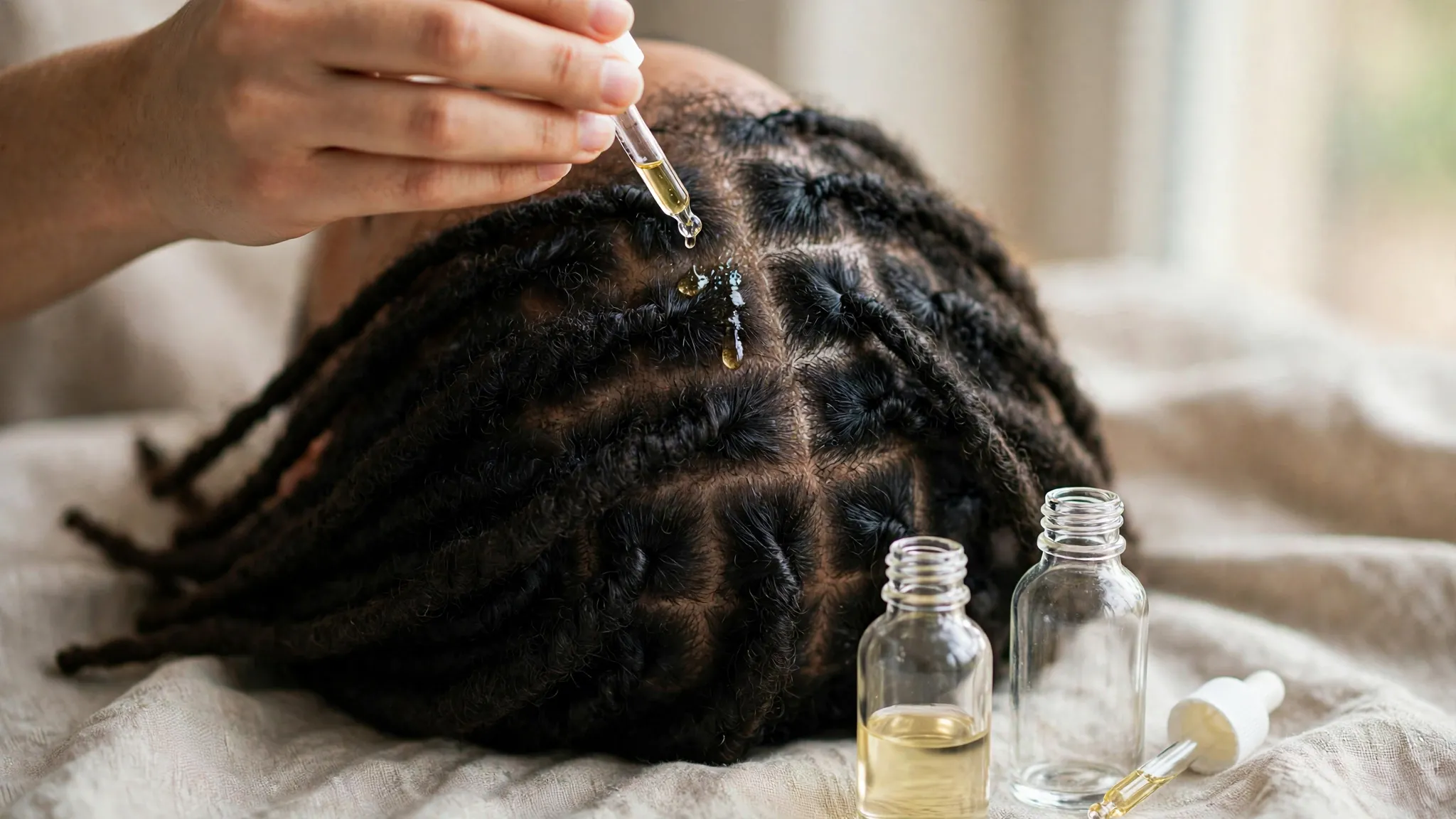
A light oil, such as jojoba oil or argan oil, is a scalp product first and a loc product second. A few drops massaged into the scalp can soothe dryness and seal in a little moisture after washing, and that is usually all that is needed. Oils do not need to be poured down the length of a loc to work.
Light oils suit dry scalps, people who wash often, and people in dry or cold weather, when the scalp loses moisture faster. A dropper or a spray makes it easier to use a small amount, and applying oil to the scalp, rather than to the whole loc, keeps the loc itself from becoming greasy and heavy.
The trade-off is that oil builds up very easily, because it does not rinse out as cleanly as water-based products. A heavy oil, or oil used every day in large amounts, can coat locs, attract lint and dust, and make a normal shampoo work harder at the next wash.
Your scalp also matters for a different reason: styles that pull too tight can damage hair at the roots over time, and no oil can fix tension damage. If a style hurts, if you see bumps, or if hair thins at the edges, that is a warning sign to loosen the style and ask a loctician or dermatologist, not to add more oil.
Choose a light oil if: your scalp feels dry after washing, and you can use a few drops only. Skip oil for now if: your locs already feel greasy, your scalp is oily, or you have buildup that a normal wash cannot remove.
Moisturising Sprays And Rose Water: Light Refreshment 08
A moisturising spray, often made with water and a light ingredient such as rose water or aloe, is a between-wash product. A light mist refreshes locs that feel dry, without soaking them the way a full wash would, and it is far easier to control than pouring a cream or oil over your head.
Sprays suit people between washes, people with dry air or dry weather, and people with small locs, because a mist reaches many small sections evenly without coating any one loc heavily. A spray bottle also lets you use water alone on some days, which is often enough for a quick refresh.
The trade-off is that a spray can still cause problems if it is used too often, or if it contains heavy oils or sweet ingredients that stay on the hair. A loc that is misted many times a day, and never fully dried, can stay damp for too long, and damp locs are more likely to smell or develop problems inside.
For rose water uses in more detail, see our Rose Water for Locs guide. This section is only about the category: a light spray is a refreshment tool, not a replacement for washing, and it should never be used to cover up a scalp problem that needs a wash or a professional check.
Choose a light spray if: your locs feel dry between washes, and you let them dry fully after misting. Skip sprays for now if: your locs already feel damp, heavy, or coated, or you are misting several times a day.
Maintenance Tools: The Products That Are Not Products 09
Some of the most useful items for locs are not products at all, and they are easy to forget when you focus on bottles. A microfibre towel or a soft cotton T-shirt, a spray bottle, a satin or silk cap for sleeping, and a clean, wide-tooth comb for separating new growth all protect locs without adding anything that can build up inside them.
A towel or T-shirt suits every wash, because squeezing locs gently and wrapping them for a short time removes water faster than rubbing, which causes frizz. A cap suits every night, because it reduces friction, lint, and loose hairs while you sleep, and it keeps locs from rubbing against rough pillowcases.
The trade-off is almost none, as long as tools are kept clean. A dirty towel, a cap that is never washed, or a spray bottle left damp for weeks can carry dirt and smell back onto clean locs, so tools need washing just like any other item that touches your hair.
For cap choices and habits, see our Dread Cap guide. The point of this section is simple: before you buy another bottle, check whether a clean towel, a spray bottle, and a cap would solve the problem for free, with no buildup risk at all.
Choose tools first if: your problem is frizz, lint, or slow drying, rather than a real lack of moisture. Skip new bottles for now if: a tool you already own, used cleanly, would do the same job.
What To Avoid: Wax, Heavy Butters, And Heavy Conditioners 10
Three categories cause most product problems for locs, and they are worth naming clearly. Beeswax and wax-based loc products, heavy butters such as thick shea butter used in large amounts, and heavy conditioners with silicones or thick creams all coat hair, and that coating does not rinse out cleanly from inside a loc.
These products suit almost no one with locs as an everyday choice, even though they can make loose hair look shiny and smooth for a day. On a loc, that shine is often a coating, and the coating traps dirt, lint, and moisture, dulls the loc over time, and makes the next wash harder, not easier.
The myth check matters here, because many people believe that a heavier product must lock hair faster, or must mean healthier hair. In practice, the opposite is often true: clean hair locks better than coated hair, and a product that stays inside a loc for months is a cost, not a benefit, even if it looked good on the first day.
That does not mean every butter or conditioner is forbidden forever, and it does not mean you must throw away a product you already own. It means that heavy products should be used rarely, in very small amounts, and only if they wash out fully, and that a product that leaves your locs feeling coated after rinsing has failed its main test.
Avoid as an everyday product if: it is wax-based, very thick, or leaves a coating after rinsing. Reconsider any product if: your locs feel heavier, duller, or smellier after using it for a few weeks, even if they looked shiny at first.
The Decision Table: Category By Scalp, Size, And Stage 11
This table matches each category to the situation where it helps most, so you can choose by need instead of by brand. Amounts and frequencies vary by hair, scalp, and loctician advice, so treat every entry here as a starting guide for questions, not as a fixed rule for your head.
| Category | Best for this scalp | Best for this size or stage | Use with care if |
|---|---|---|---|
| Residue-free shampoo | Every scalp, as the main cleanser | Every size and stage | It leaves a coating after rinsing |
| Clarifying rinse | Scalp with older buildup | Mature locs, now and then | Scalp is dry, sore, or flaky |
| Loc gel | Scalp that tolerates retwisting well | Traditional locs at retwist visits | Roots flake or scalp itches after use |
| Light oil | Dry scalp | Mature locs, a few drops only | Locs are small, oily, or coated |
| Moisturising spray | Dry scalp between washes | Small locs, light mist only | Locs stay damp for a long time |
| Heavy wax or butter | No scalp benefits from daily use | No size or stage needs it daily | Always, as an everyday product |
Notice what this table does not do: it does not rank products from best to worst, and it does not name a single winning bottle. A category that is perfect for a dry scalp can be a poor fit for an oily scalp, and a product that suits mature locs can be too heavy for starter locs.
Costs follow the same rule, and sources disagree in a useful way. One guide lists a few low-cost bottles, while salon price lists give yet other ranges, and both can be right for their own city and hair type. That is why a small bottle, tested on your own scalp first, matters more than any price list in a table.
Your Routine: Daily, Weekly, And Monthly 12
A routine is what turns a shelf of products into a habit you can actually keep, and the routine below is built from categories, not from brands. It is a starting guide, and your loctician can adjust it for your hair, scalp, and loc type, but the order matters: clean first, moisturise lightly second, style last, and never reverse that order to cover up a problem.
Daily: Protect, Refresh Lightly, And Leave Locs Alone
On a daily basis, your locs need protection more than products. Wear a cap at night, keep locs from rubbing on rough fabrics, and mist lightly only if they feel dry, then let them dry fully. Most days, the best product decision is to use no product at all, and to let your scalp rest.
Check your scalp once a day, in a mirror if you can, for redness, bumps, or thinning at the edges. Those signs matter far more than frizz, because frizz is normal and harmless, while tension and irritation are early warnings that a style, a product, or a retwist rhythm needs to change.
Weekly: Wash, Dry Fully, And Oil Lightly If Needed
On a weekly basis, or at whatever wash rhythm your hair and loctician suggest, wash with a residue-free shampoo, rinse until the water runs clear, and dry your locs fully before you cover them. Locs that stay damp can smell, feel heavy, and develop problems that are hard to fix later.

After washing, use oil only if your scalp feels dry, and use a few drops on the scalp, not a soak down the locs. If your scalp feels fine after washing, skip oil that week, because a routine that adds oil only when it is needed causes far less buildup than a routine that adds oil every time out of habit.
Monthly: Retwist, Check Buildup, And Simplify
On a monthly basis, or at your retwist rhythm, check your locs for buildup, lint, and thinning roots before you add anything new. Retwist with a thin layer of light gel only if you retwist, and ask your loctician to check tension, because a retwist that hurts is too tight, whatever product was used.
Once a month, simplify your shelf. Put aside any product you have not used in a month, any product that leaves flakes, and any product that makes locs feel coated after washing. A smaller shelf, used well, almost always beats a larger shelf, used out of habit.
Now And Then: Deep Cleanse Only When Locs Feel Coated
Now and then, when locs feel heavy or dull even after a good wash, a clarifying rinse or a deep cleanse can help, followed by a full rinse and full drying. This is not a monthly rule for everyone, and it is not a fix for everyday heavy products, because if you need a deep cleanse every week, your everyday products are the problem.
For damp-loc problems and prevention, see our Moldy Dreads guide. The routine in this section is deliberately simple: wash cleanly, dry fully, moisturise lightly, and add a product only when a clear need appears.
Choosing By Hair Type And Scalp 13
Hair type and scalp condition change product choices more than loc type alone, so start with your own head, not with a general list. Fine hair needs the lightest products, because it shows buildup quickly and breaks more easily under heavy coatings. Thick, coarse hair can handle a little more moisture, but it still suffers when heavy products are used every day.
A dry scalp needs gentle washing and a few drops of light oil after washing, not a thick cream on the locs, because the scalp is where dryness lives. An oily scalp needs the opposite: a clean, residue-free wash, and very little oil, because adding oil to an already oily scalp only adds to the coating that the next wash must remove.
A sensitive scalp needs the simplest shelf of all, with as few ingredients as possible, and every new product tested on a small area first. If a product causes itching, redness, or flakes, stop using it, even if it worked for someone else, and ask a loctician or dermatologist if the problem does not settle after you stop.
Choose simply if: your scalp is sensitive, dry, or already coated, because a simple shelf is easier to test and easier to fix. Skip a product if: it has a long list of heavy ingredients you cannot explain, and you cannot tell whether it will wash out cleanly.
Choosing By Loc Size And Type 14
Loc size and type change how much product a loc can hide, and how long it takes to dry, so they change the safest product choice. Micro locs and Sisterlocks have many small sections, so they need the lightest shampoo, the lightest spray, and the smallest amount of oil, because a small amount on each loc adds up across a whole head.
Traditional locs sit in the middle, with enough size to handle a normal wash and a light retwist gel, but not enough size to hide a heavy butter safely. Freeform locs need the least product of all, because their whole point is a natural journey with little handling, and heavy products work against that natural locking process.
Faux locs are different again, because they are temporary, and their care is about protecting your own hair underneath, not about locking it. A light spray and a gentle wash suit faux locs, while heavy products can weigh them down and stress the scalp underneath, which defeats the purpose of a temporary style.
For type choices, see our Types of Locs guide, our Micro Locs guide, and our Faux Locs guide, and for size choices, see our Dreadlock Size Chart. This section only links those guides to products: smaller locs need lighter products, and temporary locs need gentler care.
Choose lighter if: your locs are small, new, or temporary, because lighter products are easier to wash out. Skip heavy products if: your locs take a long time to dry, because a heavy product will stay inside them for even longer.
Mistakes That Turn Good Products Into Buildup 15
Using too much of a good product. A residue-free shampoo used in a large amount is still fine, but a light oil used in a large amount is not light any more. Amount matters as much as category, and a few drops, a thin layer, or a light mist is usually the right amount.
Layering products every day. Oil on top of gel, on top of spray, on top of cream, day after day, creates layers that no single wash can remove. If you use more than two products on the same day, ask yourself which one you could skip, because the answer is usually at least one of them.
Using a styling product to hide a problem. Gel to hide frizz, spray to hide smell, and oil to hide dryness can all cover a problem for a day, while making it worse over weeks. Frizz is normal, smell needs washing and full drying, and dryness needs a wash and a few drops of oil, not a heavier cover.
Skipping full drying. A good wash followed by covering damp locs under a cap or a tight style can undo the whole wash, because damp locs stay damp inside for hours. Dry locs fully, with air and time, before you cover them, and change a damp cap or towel for a dry one.
Buying a new product before fixing the old routine. A new bottle cannot fix a routine that already uses too many heavy products, washes too rarely, or never dries fully. Fix the routine first, with a residue-free wash and full drying, and only then add a new product for a clear need.
Questions To Ask Before You Buy 16
Take these questions to a shop, a website, or a consultation, and write down the answers for your own head, not just in general. A good loctician will welcome them, because they show you are choosing carefully, not just following a trend or a review.
1. Will this product rinse out fully from inside my locs, and how can I tell after one wash?
2. Is this product right for my scalp, dry, oily, or sensitive, and for my loc size and stage?
3. How much should I use, how often, and what happens if I use it too often?
4. Does this product contain wax, heavy butter, or a thick conditioner that could build up?
5. Can I test it on a small area first, and what should I do if my scalp itches or flakes?
6. If I already own a shampoo and a light oil, what clear need does this new product actually fill?
PRODUCT CHECK
- Residue-free shampoo as the main cleanser, tested on your own scalp
- Light products only, in small amounts, chosen by scalp, size, and stage
- Full rinsing and full drying after every wash, before covering locs
- No everyday wax, heavy butter, or heavy conditioner inside locs
Frequently Asked Questions About Products For Dreadlocks 17
What is the best product for dreadlocks?
There is no single best product for every person with dreadlocks, because the right product depends on your scalp, loc size, and loc stage. For most people, the closest thing to a best product is a residue-free shampoo that cleans without leaving a coating, plus a light oil only if the scalp feels dry.
What are the best hair products for dreadlocks?
The best hair products for dreadlocks, as categories rather than brands, are a residue-free shampoo, a light water-based loc gel for retwisting, a light oil for a dry scalp, and a light moisturising spray between washes. Heavy wax, heavy butters, and heavy conditioners are the categories to avoid as everyday products.
Do dreadlocks need special products at all?
Dreadlocks do not need a large shelf of special products, and many people do well with only a residue-free shampoo and a clean towel and cap. Special products help when a clear need appears, such as a dry scalp or a retwist visit, but a simple routine often beats a shelf full of bottles.
How often should I use dreadlock products?
How often you use a product depends on its category, and sources vary on exact rhythms, so use this guide as a starting point, not a fixed rule. Shampoo is used at every wash, spray is used lightly between washes, oil is used only when the scalp feels dry, gel is used at retwist visits, and clarifying rinses are used only now and then.
Can I use normal shampoo on dreadlocks?
Normal shampoo can be used only if it rinses out fully and leaves no coating, but many normal shampoos contain conditioners, silicones, or thick creams that stay inside locs. That is why a residue-free shampoo made for locs is safer as a main cleanser, even if a normal shampoo looks similar on the shelf.
Why do my dreadlocks feel coated after washing?
Locs feel coated after washing when a product used before the wash did not rinse out, such as a heavy butter, a wax, or a thick conditioner, or when the wash itself used a coating shampoo. A residue-free wash, a full rinse until the water runs clear, and full drying will usually help, and a clarifying rinse now and then can lift older buildup.
Should I oil my dreadlocks every day?
No, oiling every day is usually too much, because oil builds up easily and does not rinse out as cleanly as water-based products. A few drops on a dry scalp, after washing, and only when the scalp feels dry, is usually enough, and many people do well with oil only once a week or less.
What products should I avoid for dreadlocks?
Avoid wax-based products, heavy butters used in large amounts, and heavy conditioners with silicones or thick creams as everyday products for dreadlocks. These categories coat locs, trap dirt and lint, dull the loc over time, and make the next wash harder, even if they look shiny on the first day.
Bottom Line: Choose Fewer Products, And Choose Them Well 18
The best products for dreadlocks are not the most products, but the fewest products that pass three simple tests: they suit your scalp, they suit your loc size and stage, and they wash out fully. A residue-free shampoo, a light oil only when your scalp is dry, and a light gel only at retwist visits will cover most routines, and everything else should earn its place by filling a clear need.
Your next step is simple: look at your shelf, keep the products that pass the Product Check above, put aside the heavy products that leave a coating, and test any new product on a small area first. If your locs feel lighter after a wash, your scalp feels calm, and your locs dry fully, you have found your routine, and if they do not, simplify first, before you buy anything new.
This article is for general informational purposes only. Individual results, hair types, scalp conditions, and situations may vary. For personal hair or scalp concerns, consult a qualified loctician or dermatologist. Patch-test any new product on a small area first, and stop using it if irritation, itching, or redness appears.
